
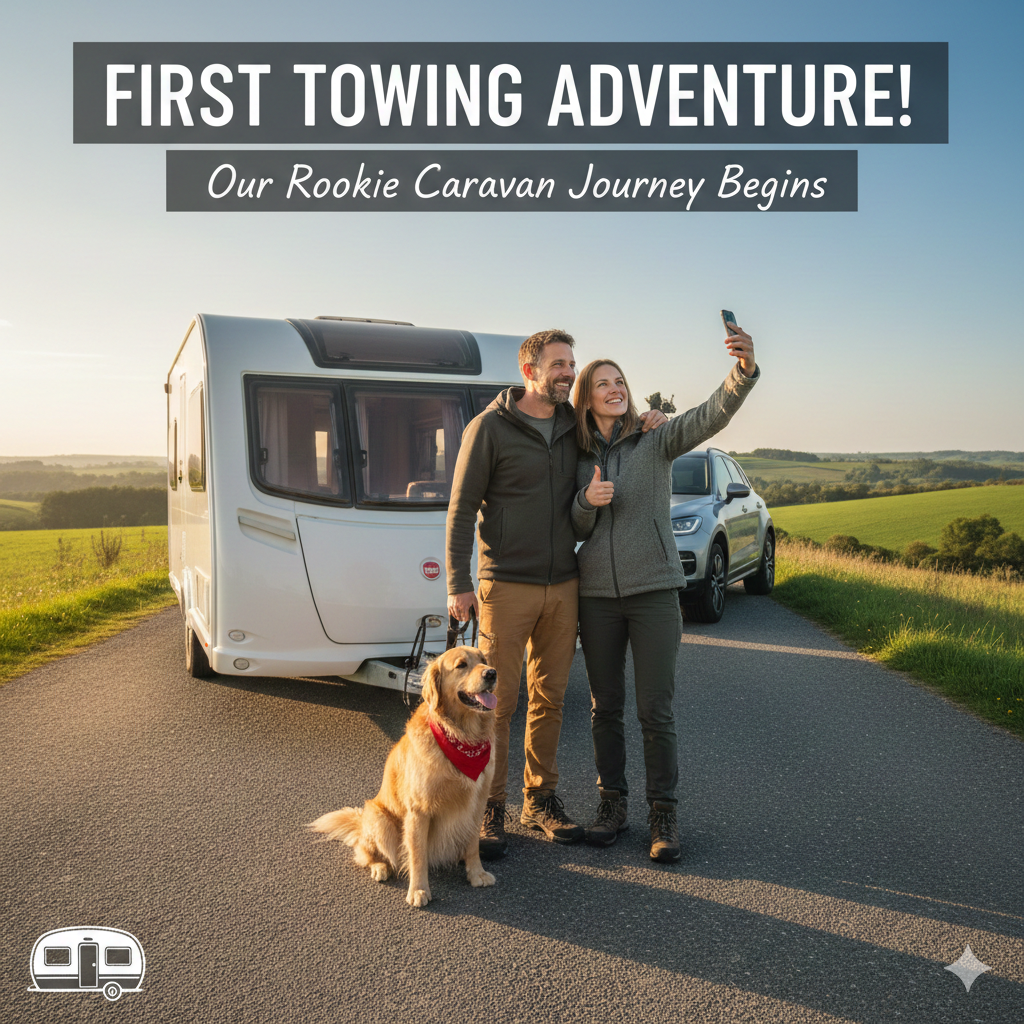
First Time Towing a Caravan on Your Own? A Practical Guide for Building Confidence
You Have Already Done the Hard Part
If you have driven motorhomes and small buses, you already understand how a large vehicle behaves — wider turns, longer braking distances, checking mirrors constantly, and being aware of your length. Towing a caravan uses the same skills with one addition: something is now attached behind you instead of being part of the vehicle.
A 16-foot pop-top behind a 3.5-tonne tow vehicle is a very manageable combination. Plenty of people tow much bigger rigs with much less experience than you already have. You will be fine.
Before Your First Trip
Planning your next road trip?
KamperHub helps you plan routes, track weights, and travel with confidence. Free to use — no credit card required.
Get Started FreeGet Familiar With Your Setup at Home
Before hitting the road, spend time in the driveway getting comfortable with the caravan and tow vehicle together.
Practice hitching up solo:
- Reverse the tow vehicle slowly until the tow ball is roughly under the coupling — a reversing camera helps enormously here, but mirrors work fine
- Wind the jockey wheel to raise the coupling higher than the tow ball
- Make small adjustments until the coupling is directly above the ball
- Lower the coupling onto the ball using the jockey wheel
- Lock the coupling in place — give it a firm tug to make sure it is seated
- Cross the safety chains — left chain to the right attachment point, right chain to the left. They should hang with some slack but not drag on the ground
- Connect the electrical plug
- Wind the jockey wheel all the way up and secure it
- Connect the breakaway cable
Do this a few times until the sequence feels natural. It will be clunky the first time and smooth by the third.
Walk-around check:
- All windows, doors, and hatches closed and locked
- Awning arms tightened
- Pop-top roof secured in travel position
- Jockey wheel fully raised and locked
- Aerial down (if fitted)
- Steps retracted
- Nothing loose inside that could fall or break during travel
Test the lights: Turn on your headlights, then walk to the back of the caravan and check that the tail lights come on. Have someone press the brake pedal and check brake lights, or use a stick/weight to press the pedal and check yourself. Activate each indicator and check they flash correctly.
Test the electric brakes: With the caravan hitched and the engine running, apply the trailer brake controller manually (the slide or lever on the controller). Try to gently drive forward. The caravan brakes should resist and you should feel the vehicle holding back. This confirms your brakes are connected and working.
Check Your Weights
With a 3.5-tonne tow capacity, you have plenty of margin for a 16-foot pop-top. But it is still worth confirming:
- Tow ball weight — should be 8–12% of the loaded caravan weight. Too light and the van can sway; too heavy and it lifts the front of your tow vehicle
- Total loaded weight — should be under the caravan's ATM (Aggregate Trailer Mass) shown on the compliance plate
- Your vehicle's GVM — remember that the tow ball weight gets added to your vehicle's mass. With passengers, fuel, and the ball weight, you need to stay under your vehicle's GVM
If you can, visit a public weighbridge with the caravan loaded the way you plan to travel. It costs $10–$20 and gives you peace of mind.
Towing Mirrors
If your caravan is wider than your tow vehicle, you need towing mirrors. Clip-on mirrors are cheap, quick to fit, and give you full vision down both sides. Being able to see past the caravan makes everything — changing lanes, merging, reversing — dramatically easier.
On the Road
Driving Tips
Most of this will feel familiar from your motorhome and bus experience:
Speed: Keep it to 90–100 km/h maximum (or the posted towing speed limit, whichever is lower). Slower is fine and absolutely nothing to be embarrassed about. Most experienced caravanners sit at 90 km/h by choice.
Following distance: Double your normal following distance. The extra weight means longer stopping distances. If someone cuts in front of you, just ease off and rebuild the gap.
Wider turns: You already know this from buses. The caravan wheels track inside your vehicle's path on corners, so swing a little wider to avoid clipping kerbs, bollards, or other vehicles.
Lane changes: Check mirrors, indicate early, and move across smoothly. The caravan follows your vehicle's path — there is no separate steering to worry about.
Overtaking: Only overtake when you have very clear road ahead. You need more distance to complete the manoeuvre because of the extra length. If in doubt, do not overtake — there is no prize for being first.
Hills: Downshift early going uphill. Use engine braking going downhill rather than riding the brakes. You have covered this in the motorhome — same principle applies.
Wind: If you feel a gust push the caravan sideways, do not overcorrect. Keep a firm grip, ease off the accelerator gently, and let the combination straighten itself out. Overcorrecting is what causes sway to get worse.
If the Caravan Starts to Sway
This is unlikely with a 16-foot pop-top behind a 3.5-tonne vehicle, but it is worth knowing:
- Do not brake suddenly — this can make sway worse
- Do not steer sharply — keep the wheel straight
- Ease off the accelerator gradually
- If you have an electric brake controller, gently apply the trailer brakes using the manual override — this pulls the caravan back in line
- The sway will settle as speed drops
The most common causes of sway are speed (too fast), load distribution (too much weight at the rear of the caravan), and low tow ball weight. If you have packed the van correctly and are driving at a sensible speed, sway is very unlikely.
Let Faster Traffic Pass
This is important for your peace of mind: you are not holding anyone up by driving at a safe, comfortable speed. The law in most states requires you to keep left if a vehicle behind wants to overtake, and there are designated overtaking lanes on most highways.
If you notice traffic building behind you on a single-lane road, indicate left and pull over at the next safe spot (a rest area, pullover bay, or wide shoulder) to let them pass. This is normal, courteous behaviour — every truckie and experienced caravanner does it. Once the traffic clears, you are back on your way stress-free.
You are not "that person" for driving at 85–90 km/h. You are a sensible driver managing a towed load safely.
Reversing — The Part Everyone Worries About
Reversing a caravan is the one genuinely new skill you will need to develop. Everything else transfers from your existing experience. Here is how to approach it.
The Basic Principle
When reversing, the caravan goes in the opposite direction to the way you turn the steering wheel. Turn the wheel left, the back of the caravan swings right. Turn the wheel right, the back of the caravan swings left.
The hand trick: Put your hand on the bottom of the steering wheel. Move your hand in the direction you want the back of the caravan to go. That is it.
Step by Step
- Get out and look — before you start, get out of the vehicle, walk behind the caravan, and check for obstacles, bollards, posts, tree branches, and anything at ground level
- Go slowly — the slower you go, the more control you have. There is no rush
- Use small steering inputs — tiny adjustments at the wheel produce big movements at the back of the caravan. Less is more
- Check both mirrors constantly — alternate between left and right mirrors so you can see both sides of the caravan
- If it starts to jackknife (the angle between vehicle and caravan gets too sharp), stop immediately, pull forward to straighten up, and start again. This is not a failure — it is the normal process
- Reverse towards the driver's side whenever possible — you have much better visibility looking out the driver's window than trying to see past the passenger side
Practice
Find a quiet car park or open area and set up a pretend campsite — use a couple of traffic cones or water bottles as markers. Practice reversing the caravan between them until you feel comfortable. Do this a few times before your first trip.
Most campsite reversing situations are actually quite simple — backing into a site that is open on one side. You do not need to be able to reverse perfectly into a tight spot. You just need to get roughly where you want to be, and you can always pull forward and adjust.
If All Else Fails
There is absolutely no shame in asking a neighbouring camper to spot you. Caravanners are some of the most helpful people you will meet. Many will wander over and offer to guide you in before you even ask.
Your First Trip — Keep It Simple
Choose Somewhere Close
For your first solo tow, pick a destination that is:
- Close to home — under two hours driving. You want to build confidence, not test endurance
- Somewhere you know — familiar roads remove one variable
- A well-equipped caravan park — powered sites, good access roads, and reasonably sized sites with easy entry angles
- Not too remote — mobile coverage is reassuring on a first trip
Tasmania has fantastic options within short driving distances, so you do not need to go far to have a great trip.
Travel When It Is Quiet
Head out mid-week if you can, or early on a Saturday morning before the traffic picks up. Quieter roads mean less pressure and more time to get comfortable.
Arrive in Daylight
Plan to arrive at the caravan park well before dark. Setting up a pop-top for the first time solo is much easier when you can see what you are doing. Give yourself at least an hour of daylight after arrival.
Tell Someone Where You Are Going
Let a friend or family member know your destination and expected arrival time. A quick text when you arrive is good practice for any solo travel.
Solo Setup Tips for a Pop-Top
A 16-foot pop-top is one of the easiest caravan types to set up solo:
- Unhitch — wind the jockey wheel down to lift the coupling off the ball, disconnect electrics and safety chains, and wind the wheel down further until the coupling clears the ball. Drive the tow vehicle forward
- Level the van — use a spirit level on the floor. Adjust height with the jockey wheel and use levelling ramps under the wheels if needed
- Stabiliser legs — wind down the corner stabiliser legs until they make firm contact with the ground. These stop the van from rocking when you move around inside
- Pop the roof — follow your van's specific mechanism. Most pop-tops lift with gas struts or a crank handle. Some newer ones have electric lifts
- Connect to power — plug in the power lead at the site's power bollard, then connect at the van
- Connect water — attach your hose to the tap and to the van's mains water inlet
- Open up — deploy the awning if you want to (or leave it for next time — there is no rule that says you have to), open windows, and set up your outdoor chair
The whole process gets faster every time you do it. By your third trip you will not even think about it.
Essential Gear Checklist
For your first few trips, make sure you have:
| Item | Why |
|---|---|
| Towing mirrors | See past the caravan on both sides |
| Wheel chocks | Stop the caravan rolling when unhitched |
| Levelling ramps | Level the van on uneven ground |
| Spirit level | Check the van is level (a phone app works too) |
| Power lead (heavy duty) | Connect to the park's power bollard |
| Drinking water hose | Connect to the park's water tap |
| Torch | Arriving late? Finding the power bollard in the dark? |
| Basic tool kit | Shifting spanner, screwdrivers, pliers, duct tape |
| Tyre pressure gauge | Check caravan and vehicle tyres before each trip |
| Wheel brace (caravan size) | May be different from your vehicle's wheel nuts |
| First aid kit | Including a snake bite kit for Tassie bush areas |
Consider a Towing Course
If you want structured, professional guidance before heading out, several organisations in Australia run beginner towing courses:
- Tow-Ed — full-day courses covering driving, manoeuvring, braking, reversing, and towing regulations at locations across the country
- RACT (Tasmania's auto club) — can advise on local options
- Let's Go Caravan and Camping — partners with various training providers
A single day of professional instruction can fast-track your confidence significantly. But plenty of people learn by starting small and building up — either approach works.
The Caravanning Community Has Your Back
One thing that consistently comes through from solo travellers is how welcoming and helpful the caravanning community is. People go out of their way to lend a hand — whether that is guiding you into a site, showing you how something on your van works, or just sharing a cuppa and some tips.
You are not on your own out there, even when you are travelling solo.
Summary
| Tip | Detail |
|---|---|
| Your experience counts | Motorhomes and buses have given you the core skills — towing is just an extension |
| Practice at home first | Hitching, walk-around checks, and reversing in a quiet space |
| Start short and close | First trip under 2 hours, somewhere familiar, well-equipped park |
| Drive at your pace | 85–90 km/h is perfectly sensible. Pull over to let traffic pass. No shame in that |
| Reversing takes practice | Hand on bottom of wheel, go slow, pull forward if needed, ask for help if stuck |
| Arrive in daylight | Setting up a pop-top solo is easy when you can see |
| Tell someone your plans | A quick text when you arrive goes a long way |
The hardest part is deciding to go. Once you are on the road with the van behind you, you will wonder what you were worried about.
KamperHub helps caravan owners plan trips, manage their rig, and stay organised on the road. [Start your free trial today](https://app.kamperhub.com).
Related Guides
- The Ultimate Caravan Pre-Departure Checklist
- Caravan Tyre Safety: Pressures, Blowouts, Load Ratings, and When to Replace
- First Time Towing a Caravan with an Isuzu D-Max X-Terrain
- Caravan Weight Compliance Explained: A Beginner's Guide
Useful Resources
Join the Conversation
Found this helpful? Try KamperHub — it's free
Weight tracking, trip planning, and towing compliance — all in one app.
KamperHub Team
Helping travellers tow safely and confidently. KamperHub provides tools for trip planning, weight compliance, and adventure management.
Plan Your Next Caravan Adventure with KamperHub
Trip planning, weight tracking, fuel management, and more. Everything you need for safe and confident towing.
Get Started Free