
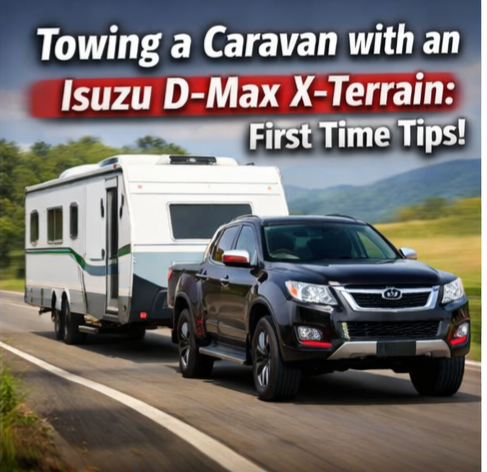
First Time Towing a Caravan with an Isuzu D-Max X-Terrain: What to Know
If you're about to tow your caravan for the first time, feeling nervous is completely normal. The good news is that the 2024 Isuzu D-Max X-Terrain is one of the most capable tow vehicles in Australia, and with a few settings adjusted and some basic checks, you'll be towing with confidence in no time.
This guide covers everything you need to know about towing a 3-tonne van with a D-Max, including which settings to change, how to set up your Hayman Reese weight distribution hitch, and practical tips for your first drive.
D-Max X-Terrain Towing Specs
Before we get into settings, here's what your X-Terrain is rated for:
| Spec | Rating |
|---|---|
| Max Braked Towing | 3,500 kg |
| Max Tow Ball Weight | 350 kg |
| GVM | 3,100 kg |
| GCM | 6,000 kg |
| Kerb Weight | 2,170 kg |
| Engine | 3.0L turbo-diesel, 140kW / 450Nm |
A 3-tonne van is well within the D-Max's 3,500kg towing capacity. You've got headroom there.
Settings to Change on Your D-Max Before Towing
Planning your next road trip?
KamperHub helps you plan routes, track weights, and travel with confidence. Free to use — no credit card required.
Get Started FreeThe D-Max doesn't have a dedicated "tow mode" like some competitors, but there are several driver assist settings (IDAS) you should adjust before hitting the road.
1. Disable Lane Support Systems
Long-press the LSS button on the steering wheel (hold for 2+ seconds). This disables:
- Lane Departure Warning (LDW)
- Lane Departure Prevention (LDP)
- Emergency Lane Keeping (ELK)
- Lane Keep Assist (LKA)
These systems can give false alerts or unwanted steering corrections when towing, especially on winding roads or when a wide caravan triggers the sensors.
2. Switch Adaptive Cruise to Standard Cruise
The D-Max X-Terrain comes with Intelligent Adaptive Cruise Control (IACC). This should not be used while towing — the system isn't designed to account for the extra weight and stopping distance of a caravan.
To switch to standard cruise control: press and hold the 'Distance' button for 2 seconds. This gives you traditional cruise control without the adaptive braking.
3. BSM and RCTA — These Handle Themselves
If you're using a genuine Isuzu tow bar wiring harness, the Blind Spot Monitor (BSM) and Rear Cross Traffic Alert (RCTA) will automatically disable when the trailer is plugged in. No action needed.
4. Tyre Pressure Monitoring
The 2024 D-Max shows real-time individual tyre pressures and temperatures on the 9-inch infotainment screen. Before you leave, check that your tyre pressures match the placard recommendations for towing (usually higher than unladen pressures). Your owner's manual has the exact figures.
Important: Settings Reset Every Start
The D-Max reactivates all IDAS features every time you turn the vehicle on. So you'll need to disable lane support and switch cruise control mode each time you start driving.
It becomes second nature after a few trips — just make it part of your pre-drive routine.
Setting Up Your Hayman Reese Weight Distribution Hitch
Weight distribution bars are essential when towing a 3-tonne van. They redistribute the towball weight across all axles, improving steering, braking, and stability. Here's how to get yours set up properly.
Before You Hitch Up
- Park on level ground — both the van and the D-Max
- Measure the wheel arch heights — front and rear of the D-Max, before coupling. Write them down
- Check your tow ball weight — for a 3T van, this is likely in the 200-300kg range. The D-Max allows up to 350kg
Connecting the Bars
- Couple the van to the tow ball as normal
- Slide the spring bars into the hitch head
- Raise the A-frame slightly above level using the jockey wheel — this lifts the rear of the D-Max and makes it easier to snap the bars into the brackets
- Engage the snap-up brackets on the A-frame and lock the safety clips
- Lower the jockey wheel fully and secure it
Check Your Setup
With the bars tensioned, measure the wheel arch heights again. The D-Max should sit approximately 15-20mm lower than unladen, and this drop should be roughly even front and rear.
If the rear is sagging significantly more than the front, the bars need more tension (move up a chain link). If the front is dipping too much, back off a link.
Tips for the Hayman Reese
- Mark the correct chain link with paint or a cable tie so you can set it up quickly next time
- Lubricate the trunnion points with a dry lubricant to reduce squeaking on tight corners
- Disengage the bars when driving up steep driveways or into tight caravan park spots — the restricted articulation can ground out
- Some noise is normal — a clunking sound on slow tight turns is expected and doesn't indicate a problem
Your Pre-Departure Checklist
Before you drive off, run through this every time:
Hitch and Safety
- Tow ball coupling locked and safety clip in place
- Safety chains crossed under the coupling and attached (not dragging on the ground)
- Weight distribution bars tensioned and safety clips engaged
- Breakaway cable connected to the vehicle (not the tow bar)
- Jockey wheel fully raised and locked
Electrical
- 12-pin plug connected
- Indicators working (both sides)
- Brake lights working
- Running lights working
- Electric brake controller set and tested (give the manual override a tap to check)
Van
- All windows and hatches closed and locked
- Entry door locked
- Awning secured
- Step retracted
- Internal items secured (fridge locked, cupboards latched)
- Gas bottles turned off
- Wheel chocks removed
- Antenna down
Vehicle
- Tyre pressures checked (vehicle and van)
- Mirrors adjusted (towing mirrors if needed)
- IDAS settings adjusted (lane support off, standard cruise)
- Fuel tank full (towing a 3T van, expect 14-18L/100km)
Driving Tips for Your First Tow
Take It Slow
There's no rush. Keep to 90-100 km/h on highways. The legal limit while towing in most states is 100 km/h, but many experienced towers stick to 90 km/h for better stability and fuel economy.
Brake Earlier Than You Think
With 5+ tonnes of combined weight behind you, stopping distances increase significantly. Leave plenty of space to the vehicle ahead and start braking well before you normally would.
Take Corners Wider
The caravan tracks inside your turning arc. Swing wider on left turns especially, or you'll clip the kerb or cut too close to obstacles.
Use Your Electric Brake Controller
If you feel any sway, a quick tap of the manual override on your brake controller will apply the trailer brakes only. This "stretches" the combination back into a straight line and settles things down.
Stay Left and Let Faster Traffic Pass
You're wider and slower than you used to be. Stay in the left lane, pull over at rest stops if traffic banks up behind you, and don't feel pressured to keep up with the flow.
Wind and Trucks
You'll feel buffeting from passing trucks and crosswinds. Keep a firm grip on the wheel, stay calm, and the D-Max's Trailer Sway Control will help manage any instability. Don't overcorrect — let the vehicle's electronics do their job.
Don't Forget
- Fuel range drops — expect around 400-450km per tank when towing (down from 700+ unladen). Plan fuel stops accordingly
- Rest often — towing is mentally tiring. Stop every 2 hours or 200km
- Practice first — if you can, do a short loop around your suburb before heading out on the highway. Get a feel for the weight, the braking, and the turning circle
- You'll be fine — thousands of Aussies tow every weekend with far less capable vehicles than an X-Terrain. After 30 minutes on the road, the nerves will fade
The Bottom Line
The 2024 D-Max X-Terrain is a seriously capable tow vehicle. For your first trip:
- Disable lane support (long-press LSS button)
- Switch to standard cruise (hold Distance button 2 sec)
- Set up your Hayman Reese bars and check wheel arch heights
- Run through the pre-departure checklist
- Drive at 90 km/h, brake early, take corners wide
You've got this.
Related Guides
- How to Choose the Right Tow Vehicle for Your Caravan
- Caravan Weight Limits Explained: GVM, ATM, GCM and Towball
- First Time Towing a Caravan on Your Own? A Practical Guide
- The Ultimate Caravan Pre-Departure Checklist
Useful Resources
Join the Conversation
Found this helpful? Try KamperHub — it's free
Weight tracking, trip planning, and towing compliance — all in one app.
KamperHub Team
Helping travellers tow safely and confidently. KamperHub provides tools for trip planning, weight compliance, and adventure management.
Plan Your Next Caravan Adventure with KamperHub
Trip planning, weight tracking, fuel management, and more. Everything you need for safe and confident towing.
Get Started Free