
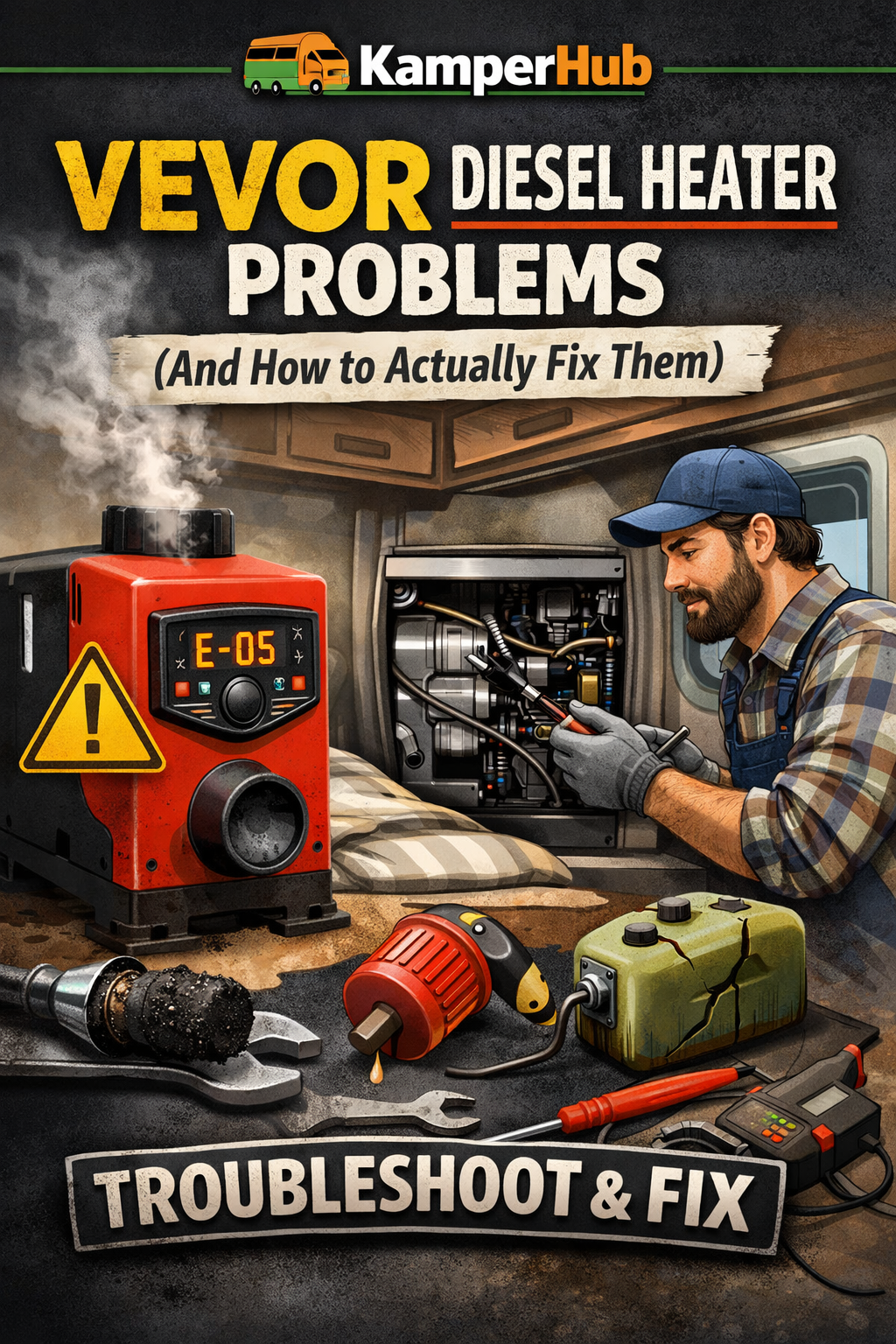
VEVOR Diesel Heater Problems (And How to Actually Fix Them)
VEVOR Diesel Heater Problems (And How to Actually Fix Them)
The budget Chinese diesel air heater — sold under VEVOR, Vevor, Happybuy and a dozen other badges — has quietly become one of the best-value upgrades in the RV world. For a couple of hundred dollars you get 5kW or 8kW of dry, toasty heat that runs off a few cents of diesel a night and doesn't touch your gas bottles.
The catch? They're cheap for a reason. The hardware is fine, but the assembly, the manuals and the quality control are hit-and-miss. The good news is that almost every common VEVOR fault is a cheap, five-minute DIY fix — not a dead unit. Here's the honest troubleshooting run-through, roughly in the order things go wrong.
⚠️ Carbon monoxide first. These heaters burn diesel inside a sealed space. The burn chamber and exhaust MUST be completely separate from the air being pushed into your van, and the exhaust MUST vent fully outside with no leaks. Fit a working CO alarm before you run one overnight, no exceptions — a caravan-rated carbon monoxide alarm costs less than a tank of diesel. Nothing below replaces that alarm.
1. White Smoke and Won't Start (First-Run Priming)
The single most common panic: you fire it up for the first time, it whirrs, glows, then puffs white smoke and shuts down — or never lights at all.
Nine times out of ten this is air in the fuel line, not a fault. Fresh out of the box the fuel pump and line are bone dry, and the pump has to suck diesel all the way from the tank before anything burns.
The fix:
- Prime it. Most controllers have a manual pump/prime function (often holding the "OK" or pump button, or a dedicated menu on the LCD/rotary controllers). Run it until you see diesel actually reach the pump and move past it toward the heater.
- No prime function? Just restart it two or three times. Each ignition cycle drags fuel a bit further up the line. White smoke that gradually turns to clear heat-haze means it's catching — let it run.
- Check the fuel line isn't kinked and the tank pickup is actually sitting in diesel.
If it lights, runs clear, then dies after a minute, that's still air — keep going, it'll clear.
2. Fuel Delivery: Pump Clicks but Nothing Burns
Planning your next road trip?
KamperHub helps you plan routes, track weights, and travel with confidence. Free to use — no credit card required.
Get Started FreeYou can hear the pump ticking away but the heater still won't sustain a flame. The pump is the heart of the system and where most ongoing gremlins live.
Work through these:
- Pump mounting angle. The dosing pump is directional and must sit at roughly 15–35° with the outlet (pump-to-heater) end higher than the inlet. Mounted flat or backwards, it can't purge air or lift fuel properly.
- Line kinks and long runs. The thin fuel line kinks easily behind panels. A too-long or too-thin line starves the burner — keep runs as short and straight as practical.
- Tank pickup. If you're drawing from a jerry can or a standpipe, make sure the pickup stays submerged as the level drops and on a slope.
- Winter gelling. In the high country in winter, standard diesel can wax up and clog the line and filter. Use a winter-grade diesel or an anti-gel additive if you camp in the cold.
Count the pump clicks: a healthy unit ticks steadily and speeds up as you raise the temperature demand. Silence from the pump points to wiring or the controller (see below), not fuel.
3. Glow Plug Failure — the #1 Wear Part
The glow plug (the ignition element) is a consumable. It's the part that eventually kills most of these heaters, and it's a $10–$20 replacement, not a new unit.
Symptoms: the heater tries to start, the fan and pump run, but there's no ignition — often paired with an ignition-fail error code. Or it starts unreliably: fine some nights, refuses others.
The fix: the glow plug lives behind the end cap of the burn chamber. Pull the cap, unscrew the plug, and check the mesh/element. A worn plug looks burnt-out, cracked or heavily carbon-clogged. Swap in a genuine-spec replacement (they're widely sold as "diesel heater glow plug + strainer" kits, usually with a new burner gauze). While you're in there, replace the little metal burner mesh too — carbon-blocked mesh causes the same no-light symptom.
4. Carbon Build-Up (Running Too Low, Too Long)
A big misunderstanding: people run these heaters on the lowest setting all night to save fuel and stay quiet. Doing that constantly is exactly what carbons them up. At low output the burn is cooler and dirtier, so soot cakes the burn chamber, the mesh and the glow plug.
Symptoms: gradually weaker heat, sooty smell, more smoke, harder starts over weeks.
The fix:
- Decarbonise. Open the burn chamber, remove the glow plug and mesh, and clean out the soot (a wire brush, carb cleaner and a vacuum do the job). Replace the mesh if it's clogged solid.
- Prevention: run it hard for 10–15 minutes at least once per session. Let it get properly hot to burn off soot before you throttle it back. Don't idle it on minimum for days on end.
5. Error Codes Decoded
The LCD controllers throw E-codes that the manual usually explains badly (or not at all). The exact numbering varies slightly between controller versions, but the common set is:
| Code | Meaning | First thing to check |
|---|---|---|
| E-00 / E-01 | Low voltage | Battery flat or thin wiring — see section 7 |
| E-02 | High voltage | Charger/alternator overvolt; check supply |
| E-03 / E-04 | Ignition failure / no flame | Glow plug, fuel priming, mesh |
| E-05 | Overheat | Blocked hot-air outlet or intake; give it airflow |
| E-06 | Fan motor fault | Fan jammed, obstructed or wiring |
| E-07 | Communication error | Controller-to-heater cable/plug loose |
| E-08 | Pump / fuel fault | Pump wiring, stuck pump, empty line |
Treat the code as a signpost, not a diagnosis — most trace back to the same handful of causes covered above.
6. Altitude: Running Rich in the High Country
Take one of these up into the alpine areas or the tablelands and it can start smoking, sooting and struggling — even a unit that ran perfectly at sea level. Less oxygen up high means the fixed fuel dose burns rich.
The fix: better controllers have an altitude/plateau mode or let you trim the fuel-pump frequency down manually. Drop the fuel delivery a notch or two when you're camped up high and the smoke clears. Cheaper controllers without the setting will simply run dirtier at altitude — factor that into a decarbonise cycle after an alpine trip.
7. Voltage and Wiring Gremlins
These heaters are fussy about clean 12V. An undervolt shutdown mid-night is one of the most common "it just stopped" complaints, and it's almost always supply, not the heater.
Work through:
- Cable gauge. The thin wiring in the kit is often too light for the run. On the 8kW units especially, upsize the power cable and keep the run short. Voltage drop under load triggers low-voltage cutouts.
- Direct to the battery. Wire it to the house battery through its own fused circuit, not off some convenience accessory line.
- Connections. Check every crimp and the controller plug — a loose comms plug throws communication errors and random dropouts.
- Battery state. A tired battery that sags under the fan's startup draw will cut the heater out even when the fridge is fine.
8. Exhaust, Intake and Noise
Get the plumbing wrong and you turn a good heater into a hazard or an annoyance.
- Exhaust must vent fully outside, run downhill where possible so condensation drains out, and never dump near a window, door or the combustion air intake. Fit the muffler — it cuts noise noticeably.
- Combustion air intake should draw fresh outside air, kept away from the exhaust so it can't re-breathe fumes.
- Ticking fuel pump. That metronome tick keeping you awake is the pump. Mount it on the rubber isolator it came with (or add one), away from panels that act as a soundboard, and it drops to a background tap.
When It's Actually Worth Replacing vs Fixing
Because the parts are so cheap, "throw it away" should almost never be your first move. A glow plug, a mesh, a length of fuel line, a new pump and a decarbonise between them fix the overwhelming majority of faults for well under $50.
Genuinely consider replacing the whole unit only when: the main control board is dead (no response, no fan, confirmed good power), the fan motor has seized and a replacement costs more than half a new heater, or the burn chamber itself has cracked or rusted through. At that point a fresh unit — or stepping up to a branded heater — is the better spend.
Related reading: A VEVOR-style unit only heats cabin air — it won't give you a hot shower. If you want both, that's a different appliance: see Diesel Hot Water & Heater Combos: How Long Does 10 Litres Really Last in the Shower?
Heat Is Only Half the Off-Grid Picture
A diesel heater sips fuel, but the fan, pump and glow plug still pull 12V — and on a cold night that draw adds up. If you free-camp in winter, it pays to know how long your battery actually lasts with the heater, fridge and lights all running.
That's exactly what KamperHub's Power System planner is for: set your battery and solar, add your appliances, and see your realistic days off-grid before you're the one sitting in the dark at 4am. Pair it with the trip planner and you can pick winter free-camps knowing your rig can actually keep you warm through the night.
Stay warm, keep a working CO alarm fitted, and enjoy the shoulder-season camping the rest of the caravan park is missing out on.
Join the Conversation
Found this helpful? Try KamperHub — it's free
Weight tracking, trip planning, and towing compliance — all in one app.
KamperHub Team
Helping travellers tow safely and confidently. KamperHub provides tools for trip planning, weight compliance, and adventure management.
Plan Your Next Caravan Adventure with KamperHub
Trip planning, weight tracking, fuel management, and more. Everything you need for safe and confident towing.
Get Started Free