
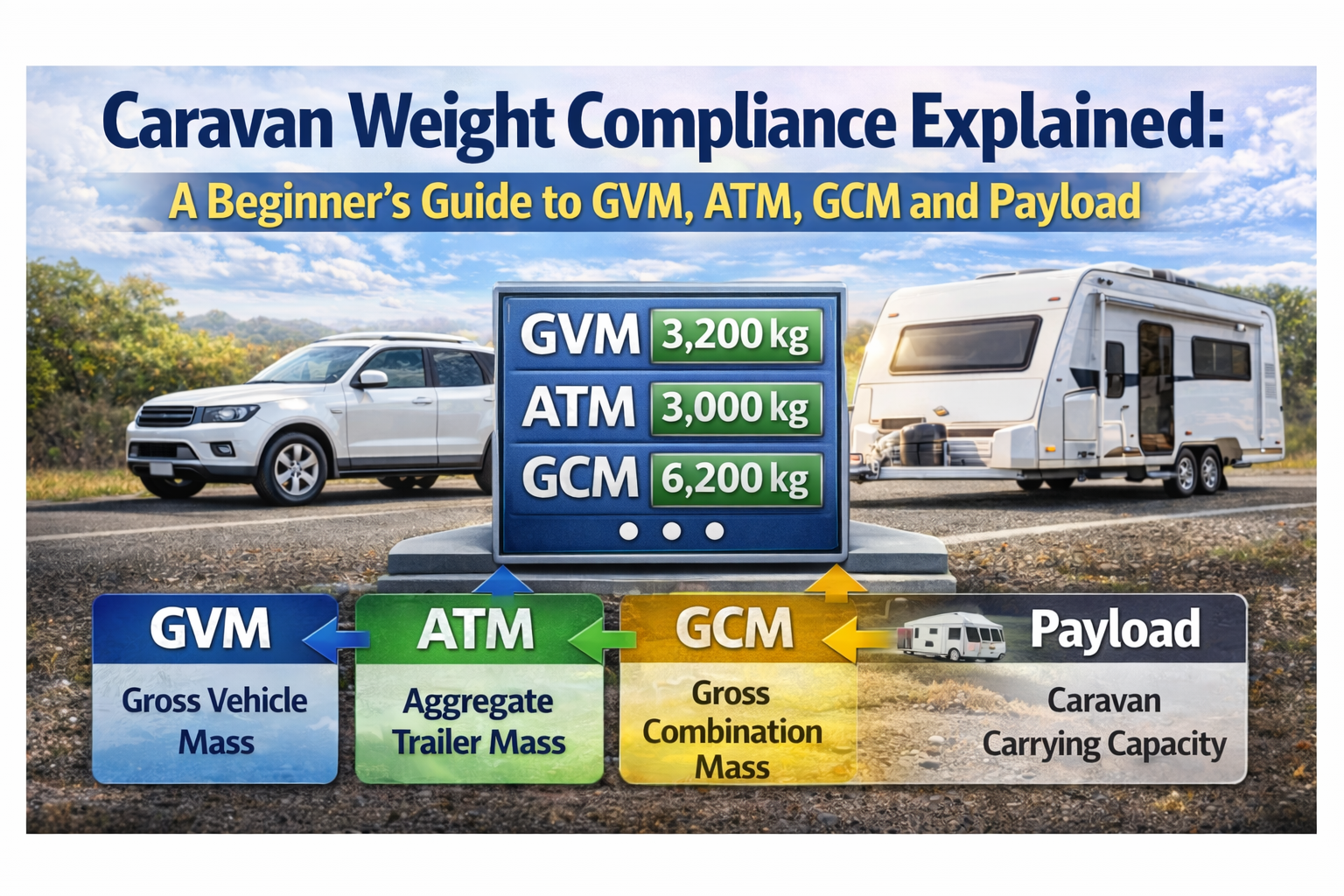
Caravan Weight Compliance Explained: A Beginner's Guide to GVM, ATM, GCM and Payload
If you've recently bought a caravan — or you're thinking about it — you've probably been hit with a wall of acronyms. GVM, ATM, GCM, GTM, Tare, Payload, Towball weight. It can feel like you need an engineering degree just to hook up and go. But here's the thing: understanding these numbers isn't optional. It's the difference between a safe, legal trip and a dangerous, expensive disaster. The good news? It's not actually that complicated once someone explains it properly. That's what this guide is for.
Why Weight Compliance Matters (Really Matters)
Let's get the serious stuff out of the way first. Overloading your caravan or tow vehicle isn't just a technical breach of some obscure regulation. It has real consequences.
Safety. An overloaded caravan is unstable. It sways more at highway speeds, takes longer to stop, and puts enormous stress on your tyres, suspension and brakes. Tyre blowouts on caravans are overwhelmingly caused by overloading — not road debris, not age, not bad luck. When a tyre lets go at 100 km/h on the Pacific Highway, the results can be catastrophic.
Fines. Every state and territory in Australia has laws around vehicle weight limits. If you're pulled over at a roadside inspection and found to be over your rated weights, you're looking at fines that can run into the thousands. In Queensland, overloading penalties start at around $575 and go up steeply from there. In New South Wales, fines can exceed $2,200 for substantial breaches.
Insurance. This is the one that catches people off guard. If you have an accident while overloaded, your insurer can — and frequently does — deny your claim. It doesn't matter if the overloading wasn't the direct cause of the accident. If your vehicle or caravan was over its rated weight at the time of the incident, you may have voided your policy. That $80,000 caravan? You're wearing it.
Mechanical damage. Running overweight accelerates wear on every component in the drivetrain. Transmission, differentials, wheel bearings, brakes, suspension — all of it wears faster when you're over the limit. The repair bills add up quickly, and none of it is covered under warranty if overloading is the cause.
The Acronyms Explained — In Plain English
Planning your next road trip?
KamperHub helps you plan routes, track weights, and travel with confidence. Free to use — no credit card required.
Get Started FreeHere's every weight term you need to know, explained without the jargon.
Tare Weight
The weight of the vehicle or caravan as it left the factory. No fuel, no water, no gear, no passengers. Just the bare unit with standard equipment. Think of it as the "empty" weight, though in practice it's never truly empty because it includes things like the spare tyre and gas bottles (empty).
For caravans, the tare weight is stamped on the compliance plate. But be careful — if the dealer added accessories before you picked it up (a bull bar, toolbox, solar panels, an extra battery), those aren't included in the tare weight. Your caravan is already heavier than the plate says before you've packed a single thing.
Payload
Payload is the weight you're allowed to add on top of the tare weight. It's calculated simply:
Payload = Maximum rated weight − Tare weight
For a tow vehicle, payload includes passengers, fuel, everything in the cabin and tray, and the towball download weight from the caravan.
For a caravan, payload includes water (full tanks can add 100-200 kg alone), food, clothing, gas bottles (full), camping gear, tools — everything you put in it.
Payload is where most people get caught out. A caravan with a tare weight of 2,100 kg and an ATM of 2,500 kg only has 400 kg of payload. That sounds like a lot until you fill the water tanks (160 kg for 160 litres), add two full gas bottles (18 kg each), and start loading your gear.
GVM — Gross Vehicle Mass
The maximum your tow vehicle is legally allowed to weigh when fully loaded. This includes the vehicle itself, all passengers, fuel, cargo in the cabin and tray, and the towball download weight from whatever you're towing.
GVM is set by the vehicle manufacturer and is non-negotiable (unless you get a certified GVM upgrade, which we'll touch on later). You'll find it on the compliance plate, usually on the driver's door jamb or under the bonnet.
ATM — Aggregate Trailer Mass
The maximum your caravan is legally allowed to weigh when fully loaded and standing on its own wheels. This is the caravan equivalent of GVM. It includes the caravan itself plus everything in it — water, gas, gear, the lot.
ATM is found on the caravan's compliance plate, usually on the drawbar or A-frame.
GTM — Gross Trailer Mass
The maximum weight on the caravan's axle(s) when it's connected to the tow vehicle. GTM is always slightly less than ATM because some of the caravan's weight is transferred to the tow vehicle through the towball (that's the towball download weight).
GCM — Gross Combined Mass
This is the big one that most people overlook. GCM is the maximum combined weight of your tow vehicle AND your caravan, fully loaded, at the same time.
Here's why GCM matters so much: your vehicle might have a towing capacity of 3,500 kg and a GVM of 3,100 kg. Plenty of capacity, right? But if the GCM is 6,000 kg, then a fully loaded vehicle at 3,100 kg can only tow a caravan weighing up to 2,900 kg — not 3,500 kg.
The formula: Loaded vehicle weight + Loaded caravan weight must not exceed GCM.
GCM is the limit that catches the most people, because dealers rarely mention it.
Towball Weight (Download Weight)
The downward force the caravan's coupling exerts on the towball. This should be between 8-14% of the caravan's loaded weight for safe towing. Too little and the caravan will sway dangerously. Too much and it overloads the rear axle of the tow vehicle, lifting the front wheels and reducing steering control.
Towball weight counts towards your tow vehicle's GVM — it's weight sitting on your vehicle, after all. This is the detail that trips up a lot of owners.
Quick Reference Table
| Acronym | Full Name | Applies To | What It Means |
|---|---|---|---|
| Tare | Tare Weight | Both | Empty weight as delivered from factory |
| Payload | Payload Capacity | Both | How much you can add (max weight minus tare) |
| GVM | Gross Vehicle Mass | Tow vehicle | Max loaded weight of the vehicle |
| ATM | Aggregate Trailer Mass | Caravan | Max loaded weight of the caravan |
| GTM | Gross Trailer Mass | Caravan | Max weight on caravan axles when hitched |
| GCM | Gross Combined Mass | Tow vehicle | Max combined weight of vehicle + caravan |
| Towball | Towball Download Weight | Both | Downward force on towball (8-14% of loaded caravan) |
How to Find Your Weight Ratings
For Your Tow Vehicle
- Compliance plate. Usually on the driver's door jamb, the B-pillar, or under the bonnet. It lists GVM, GCM, and maximum axle loads.
- Owner's manual. The towing section will list towing capacity, maximum towball download, and GCM.
- Registration papers. Your state rego papers typically show GVM and tare weight.
- Manufacturer's website. Look up the specifications for your exact model and variant. Be precise — the same model can have different ratings depending on the engine, transmission, cab style and tray configuration.
For Your Caravan
- Compliance plate. On the drawbar or A-frame. Shows ATM, GTM, and tare weight.
- Owner's manual or build sheet. The manufacturer should provide detailed weight specifications.
- Dealer documentation. Ask for the actual weighed weight if the dealer fitted accessories before handover. The compliance plate tare weight won't include dealer-fitted extras.
Important: The compliance plate is the legal document. If the owner's manual and compliance plate disagree, the compliance plate wins.
The Weighbridge Test — How to Do It
A weighbridge is a large industrial scale, usually found at waste transfer stations, quarries, grain silos, and some truck stops. Getting weighed is the only way to know your actual weights — guessing is not good enough.
What It Costs
Typically $15-30 for a set of weighs. Some places charge per weigh, others charge a flat fee. Call ahead to check prices and opening hours. Many weighbridges close on weekends.
How to Find One
Search for "public weighbridge near me" or check with your local council. The National Measurement Institute maintains a register of certified weighbridges, and most caravan clubs have lists of locations around Australia. There are weighbridges in most regional towns — you don't need to be in a capital city.
The Weighing Process
You want four separate measurements. Load your vehicle and caravan exactly as you would for a trip — full water tanks, full fuel tank, all gear packed, passengers on board.
- Vehicle and caravan together, connected. Drive the whole rig onto the weighbridge. This gives you the gross combined weight (check against GCM).
- Tow vehicle only. Unhitch the caravan and drive just the vehicle onto the weighbridge. This gives you the loaded vehicle weight (check against GVM). Remember, the towball download weight is no longer on the vehicle at this point, so add it back mentally.
- Caravan only. Put the caravan on the weighbridge by itself, resting on its jockey wheel. This gives you the loaded caravan weight (check against ATM).
- Towball weight. This requires a towball weight scale (a portable device you can buy for $50-150, or borrow from a caravan club). Place it between the coupling and a solid surface with the caravan loaded and level.
Write down every number. Take photos of the weighbridge tickets. You'll want these records for insurance purposes and future reference.
When to Weigh
Weigh your rig before your first trip, and again whenever you make significant changes — new accessories, a different packing arrangement, or a new caravan. Ideally, do a weigh at least once a year. It's remarkable how gear accumulates over time.
Common Mistakes
Not accounting for accessories. A bull bar adds 40-70 kg. A long-range fuel tank adds the tank weight plus the extra fuel. A rooftop tent can add 50-80 kg. Toolboxes, winches, driving lights, rear bars with tyre carriers — it all adds up. Many vehicles are already approaching their GVM before you've put a single thing inside.
Full water tanks. Water weighs 1 kg per litre. A caravan with two 80-litre tanks adds 160 kg when full. Most experienced tourers travel with tanks half full or less and top up at each stop. There's rarely a good reason to travel with completely full tanks on Australian highways.
Ignoring the GCM limit. You can be under GVM and under ATM and still be over GCM. Always check all three limits.
Trusting the brochure payload figure. Manufacturers list the payload based on the bare tare weight. But by the time the dealer has fitted an air conditioner, solar panels, a lithium battery upgrade, extra water tanks, and an annexe, you might have lost 200 kg of payload before taking delivery.
Not weighing regularly. Your first trip might be compliant. But over three years of accumulated "just one more thing," you can easily creep over the limit without realising it.
Packing heavy items high or at the rear. Even if you're within weight limits, poor weight distribution causes instability. Heavy items should go low, centred over or slightly ahead of the axle(s) in the caravan.
Practical Tips for Staying Compliant
- Weigh early and weigh often. Get a baseline weight for your vehicle and caravan with standard gear. Know exactly how much payload margin you have.
- Keep a weight register. List every item you carry and its weight. Bathroom scales work fine for most gear. A simple spreadsheet saves arguments and surprises.
- Prioritise ruthlessly. Do you really need the cast iron camp oven AND the portable pizza oven AND the sandwich press? Every kilogram of unnecessary gear is a kilogram you can't use for something essential.
- Travel with partial water tanks. Fill up when you arrive at camp. Unless you're heading to a remote area with no water, there's no need to carry full tanks on the highway.
- Upgrade wisely. If you're consistently close to the limit, consider a GVM upgrade for your tow vehicle (available from companies like Lovells, ARB, and specialist engineers). These are certified upgrades that legally increase your GVM.
- Check towball weight. A towball weight gauge is a cheap investment. Check it with the caravan loaded for a trip — not empty in the driveway.
- Question dealer claims. "She'll tow 3.5 tonne easy" is not engineering advice. Always verify against the compliance plate and GCM.
How KamperHub Helps
KamperHub's weight compliance dashboard lets you enter your vehicle and caravan specs, add accessories and gear, and see exactly where you stand against every weight limit — GVM, ATM, GCM, towball weight, and payload remaining. It flags issues before you leave the driveway, so you can adjust your loadout rather than finding out at a roadside inspection. It's one of the most-used features in the app, and it's available as part of the TowReady pack.
The Bottom Line
Weight compliance isn't glamorous. Nobody buys a caravan because they're excited about visiting a weighbridge. But understanding these numbers — and actually checking them with real weights on a real scale — is the foundation of safe towing. It protects your family, your investment, your insurance coverage, and your licence.
Take an hour this weekend to find your compliance plates, write down the numbers, and book a weighbridge visit before your next trip. It's the single best thing you can do for your safety on the road.
Check Your Weights with KamperHub
KamperHub's free caravan towing weight calculator checks your GVM, ATM, GCM, towing capacity and towball weight in under two minutes. Want to go deeper? The tow simulator models your complete setup with visual weight distribution and sway risk analysis.
Worried about fines? See the full state-by-state overweight penalties guide.
Related Guides
- Caravan Weight Limits Explained: GVM, ATM, GCM and Towball Weight
- Overweight Caravan Fines in Australia: State-by-State Penalties in 2026
- How to Choose the Right Tow Vehicle for Your Caravan
- The Ultimate Caravan Pre-Departure Checklist
Useful Resources
Join the Conversation
Found this helpful? Try KamperHub — it's free
Weight tracking, trip planning, and towing compliance — all in one app.
KamperHub Team
Helping travellers tow safely and confidently. KamperHub provides tools for trip planning, weight compliance, and adventure management.
Plan Your Next Caravan Adventure with KamperHub
Trip planning, weight tracking, fuel management, and more. Everything you need for safe and confident towing.
Get Started Free