
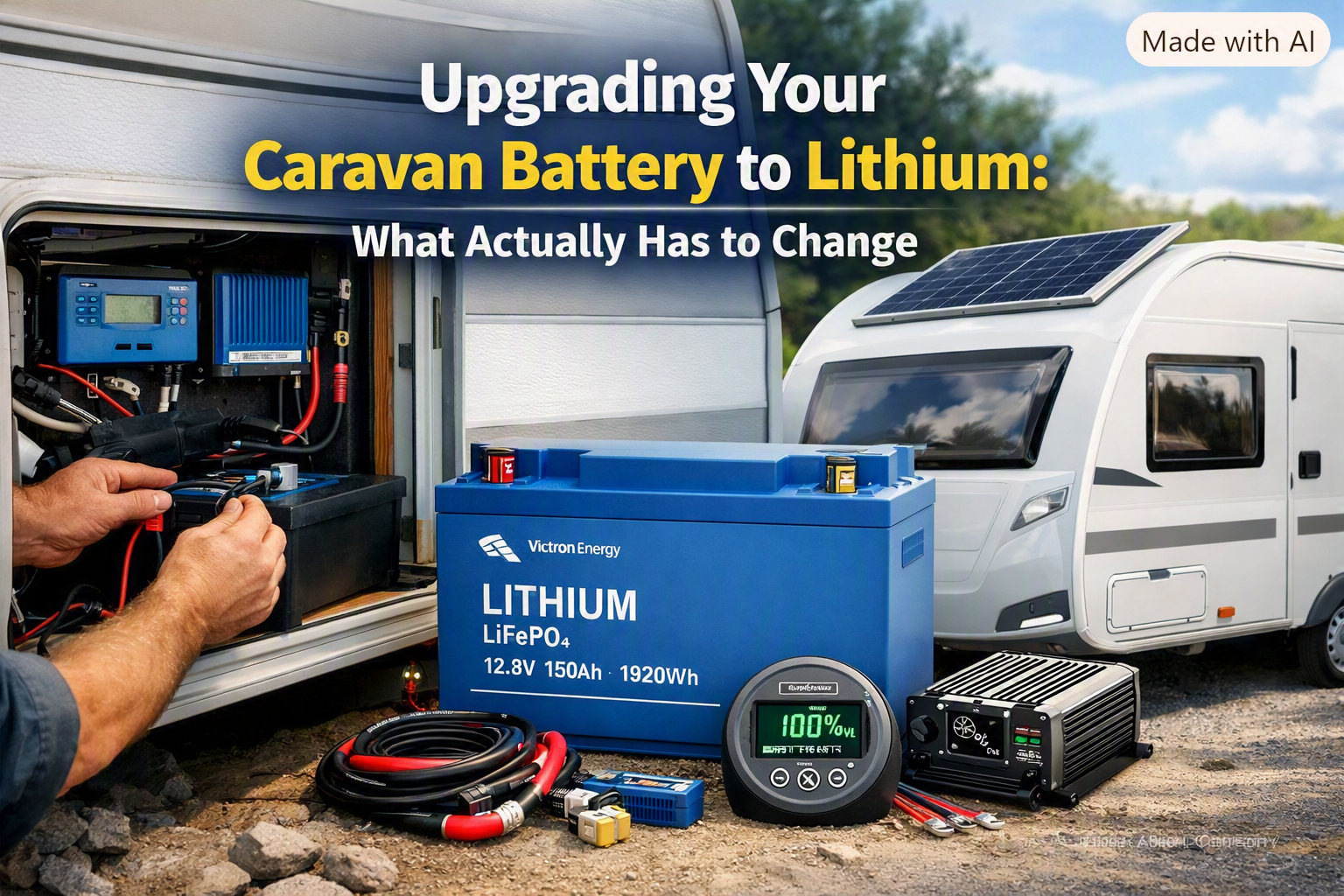
Upgrading Your Caravan Battery to Lithium: What Actually Has to Change
The Upgrade Nobody Explains Properly
Ask around a caravan park and you'll hear the same advice: "Just put lithium in, mate." What you won't hear is that the battery is the cheapest part of the job.
Swapping a battery is a ten-minute task. Swapping a battery chemistry changes how your van charges, how much it weighs, where the weight sits, and whether your existing chargers will do anything useful at all. Get it wrong and you'll spend $1,000 to end up with a battery that never charges past 80%.
This guide covers what actually has to change — and how to work out whether the upgrade is worth it for the way you travel.
Step 1: Understand What You're Actually Buying
Planning your next road trip?
KamperHub helps you plan routes, track weights, and travel with confidence. Free to use — no credit card required.
Get Started FreeThe headline number on the side of a battery is not the number that matters.
Every deep-cycle battery has a usable portion — the depth of discharge (DoD) you can run to without wrecking it:
| Chemistry | Usable capacity | Cycle life |
|---|---|---|
| Lithium (LiFePO4) | 80% | ~3,000 cycles |
| AGM | 50% | ~500 cycles |
| Lead acid (flooded) | 50% | ~300 cycles |
So the real comparison isn't 100Ah against 100Ah. It's:
- 100Ah AGM → 50Ah you can actually use
- 100Ah lithium → 80Ah you can actually use
One 100Ah lithium battery replaces about 160Ah of AGM. That's the single most useful sentence in this guide. Most people upgrading from a pair of 100Ah AGMs find that a single 200Ah lithium is a genuine upgrade, not a like-for-like swap.
It also means the honest way to compare prices is per usable amp-hour, not per amp-hour on the label.
Step 2: Do the Weight Maths (This Is the Part People Miss)
Lithium's biggest practical advantage in a caravan isn't the power. It's the weight.
- 100Ah AGM: roughly 27–32 kg
- 100Ah LiFePO4: roughly 11–14 kg
Replace two 100Ah AGMs with one 200Ah lithium and you take something like 35–40 kg out of the van.
Here's why that matters more in a caravan than in a boat or a shed: house batteries are very often mounted on or near the A-frame, right at the front of the van. Weight at the front of a van doesn't just come off your payload — it comes off your towball mass, and it comes off at a big lever.
That cuts both ways:
- If your towball weight is too high (the common problem), moving to lithium up front can pull you back within limits without moving a single item of gear.
- If your towball weight is already on the low side, dropping 35 kg off the drawbar can push you under the recommended range — and too little towball weight is the setup most associated with sway.
Don't guess at this. Re-check your numbers after the upgrade, the same way you would after fitting a new toolbox or a second spare.
Step 3: Work Out What Else Has to Change
This is where upgrades go wrong. A LiFePO4 battery wants a different charge profile to a lead-acid one, and most of the gear already in your van is set up for lead acid.
Your 240V charger
Lead-acid chargers use a long absorption phase and a float voltage that LiFePO4 doesn't want, and some finish at a voltage too low to ever fill a lithium battery. If your charger has a lithium profile, select it. If it doesn't, budget to replace it — otherwise you've bought 200Ah and you'll be using a fraction of it.
Your solar regulator
Same story. Most decent MPPT controllers have a lithium or user-defined profile. Old PWM controllers often don't. Check before you buy the battery, not after.
Charging from the vehicle
If you charge while driving, you need a DC-DC charger — and with lithium it stops being optional.
Two reasons. First, lithium's very low internal resistance means it will accept enormous current, and wiring it directly to the alternator can pull far more than the alternator was designed to deliver continuously. Second, most vehicles built in the last decade use a variable-voltage ("smart") alternator that deliberately drops output voltage once the starter battery is topped up — which will never fill a lithium house battery.
A DC-DC charger solves both: it limits the current the alternator sees, and it delivers a proper lithium charge profile regardless of what the alternator is doing.
Cold weather
This is the one genuinely new limitation lithium brings. LiFePO4 must not be charged below about 0°C. A good battery has a BMS that blocks charging when it's too cold — which is protection working correctly, but it can look like a dead battery on a frosty morning in the high country.
If you do winter trips inland or at altitude, buy a battery with low-temperature charge protection (all reputable ones have it) and consider one with self-heating if you're regularly below freezing overnight. Discharging in the cold is fine — it's only charging that's restricted.
Where it lives, and what holds it in
Sealed lithium and AGM batteries can be mounted inside the van. Flooded lead-acid cannot — it vents gas and needs an external, ventilated box. So an upgrade is often a chance to bring the battery inboard and out of the weather.
Two things not to skip: the battery must be properly restrained (a battery that comes loose in a rollover or heavy braking is a serious hazard, and it's much lighter now than the strap was sized for), and the fusing and cable size must suit the higher currents lithium can deliver. A lithium battery can push a very large current into a short circuit.
Step 4: Work Out Whether It's Worth It
Roughly, as a rule of thumb for budgeting:
| Chemistry | Approx. cost per Ah | 200Ah bank |
|---|---|---|
| Lithium (LiFePO4) | ~$4.50 | ~$900 |
| AGM | ~$2.00 | ~$400 |
| Lead acid (flooded) | ~$1.50 | ~$300 |
Lithium looks like double the price. Per cycle, it isn't close:
- $900 lithium ÷ 3,000 cycles = about $0.30 per cycle
- $400 AGM ÷ 500 cycles = about $0.80 per cycle
And that comparison is generous to AGM, because it ignores that you need roughly 1.6× the AGM capacity to get the same usable power.
The catch is that cost-per-cycle only pays off if you use the cycles. A lithium battery replaced on a 10-year cycle life doesn't care whether you did 3,000 cycles or 300.
Upgrade if you:
- Free camp regularly, or want to
- Are close to your payload or towball limits
- Run a compressor fridge plus an inverter
- Are already replacing a tired AGM bank anyway
- Travel enough that the cycles will actually get used
Don't bother yet if you:
- Stay mostly in powered sites
- Have healthy AGMs with years left in them
- Only get away a few weekends a year
- Can't also budget for the charger and DC-DC changes — a lithium battery on lead-acid charging gear is money wasted
Step 5: Size It Before You Buy It
The most expensive mistake is buying on the advice of whoever you spoke to last. Work out your actual daily consumption, then size the bank to it.
Our Battery Runtime Calculator takes your battery bank and appliance list and tells you how long you'll last. The Power System Planner works the other way — from your appliances to the battery, solar and charging you need.
Battery Runtime Calculator → Power System Planner → Battery Buying Guide — Lithium vs AGM vs Lead Acid →
The Short Version
- 100Ah of lithium ≈ 160Ah of AGM. Compare usable capacity, not labels.
- You'll drop 35–40 kg, usually off the front of the van — re-check your towball weight afterwards, in both directions.
- Budget for the charging gear, not just the battery. Charger, solar controller and DC-DC all need lithium profiles.
- Don't charge below 0°C. Buy low-temperature protection; buy self-heating if you chase the cold.
- Re-do the fusing and the restraint. Higher current, lighter battery.
- Size it against your real usage before you spend anything.
Related Guides
- How to Size Your Caravan Power System (Without Getting It Wrong)
- Best Caravan Solar Panels in Australia (2026 Buying Guide)
- Do Solar Panels in Parallel Add Up in Wattage?
- How to Set Up an External Fridge Without Killing Your Battery
- 12V Caravan Electrical Problems: 10 Issues You Can Fix Yourself
- Caravan Weight Limits Explained — GVM, ATM, GCM and Towball
Useful Resources
Join the Conversation
Found this helpful? Try KamperHub — it's free
Weight tracking, trip planning, and towing compliance — all in one app.
KamperHub Team
Helping travellers tow safely and confidently. KamperHub provides tools for trip planning, weight compliance, and adventure management.
Plan Your Next Caravan Adventure with KamperHub
Trip planning, weight tracking, fuel management, and more. Everything you need for safe and confident towing.
Get Started Free