
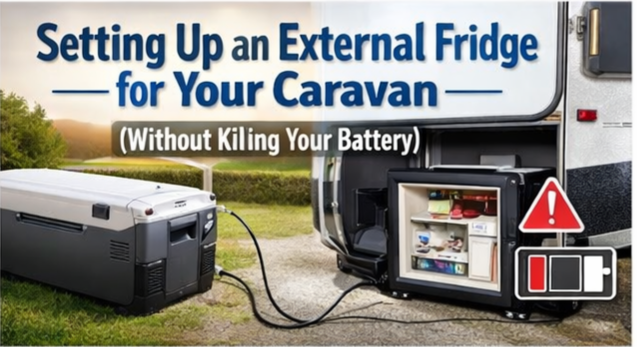
How to Set Up an External Fridge for Your Caravan (Without Killing Your Battery)
The Basics: Why External Fridges Drain Batteries
A 12V compressor fridge is one of the biggest constant power draws in a caravan setup. Unlike lights or a phone charger that you use briefly, a fridge runs 24 hours a day, cycling on and off to maintain temperature.
A typical 90L dual zone fridge draws 0.8–1.2 Ah per hour on average. Over 24 hours, that is 19–29 Ah — a significant chunk of most caravan battery setups.
Battery Sizing Guide
Planning your next road trip?
KamperHub helps you plan routes, track weights, and travel with confidence. Free to use — no credit card required.
Get Started FreeRule of thumb
You need enough usable battery capacity to run the fridge overnight (12–14 hours) without other charging sources, plus a safety margin.
For a 90L dual zone fridge (approx 1.0 Ah/h average):
| Battery Type | Total Capacity Needed | Why |
|---|---|---|
| AGM (50% usable) | 200Ah minimum | Only discharge to 50% to preserve battery life |
| Lithium (80% usable) | 120Ah minimum | Can safely discharge to 20% remaining |
What most caravanners run
- Budget setup: Single 120Ah AGM — tight, but works with solar backup
- Comfortable setup: 200Ah lithium — handles fridge plus lights, charging, and a fan
- Overkill (but nice): 300Ah+ lithium — run everything without thinking about it
Solar Requirements
Solar panels recharge your batteries during the day so they can power the fridge overnight.
Minimum solar for a 90L fridge:
- 200W panel: Adequate in summer, may struggle in winter or overcast conditions
- 300W panel: Comfortable year-round in most of Australia
- 400W+ panels: Handles the fridge plus other loads without stress
Key factors
- Panel angle and orientation matter more than raw wattage in winter
- Shade on even one cell can dramatically reduce output
- An MPPT solar controller is significantly more efficient than PWM
Wiring Your External Fridge
Anderson plug setup (most common)
- Run a dedicated circuit from your battery to an Anderson plug mounted externally
- Use minimum 6mm² (13.5mm² for longer runs over 3m) twin core cable
- Install a 15A fuse or circuit breaker at the battery end
- Mount the Anderson plug where your fridge slide sits
Key wiring tips
- Keep cable runs short — voltage drop over long thin cables wastes energy and can cause compressor issues
- Use quality Anderson plugs — cheap copies have higher resistance and can overheat
- Add a low voltage disconnect — protects your starter battery if the auxiliary runs flat. Most modern fridges have built-in low voltage cutoff, but an external one adds a safety layer
- Avoid running through the cigarette lighter socket — these are limited to 10–15A and the connections are unreliable for constant loads
Fridge Placement Tips
On a fridge slide
- Ensure the slide is rated for the loaded weight (fridge + contents = 40–50kg)
- Allow ventilation clearance around the compressor (usually at the back)
- Secure the fridge to the slide with straps or bolts — it will move on corrugated roads
Inside the caravan
- Provide airflow around the compressor — heat buildup reduces efficiency
- Consider a fan to circulate air around the unit in hot weather
- Factor the weight into your caravan's rear payload if it is behind the axle
Tips to Reduce Power Draw
- Pre-cool the fridge on 240V before leaving home — it uses far less power to maintain temperature than to cool down from ambient
- Keep it in shade — direct sun on the fridge body forces the compressor to work harder
- Minimise lid openings — every open lets warm air in. Know what you want before you open it
- Pack it full — a full fridge holds temperature better than a half-empty one. Fill gaps with bottles of water
- Set realistic temperatures — fridge at 3–5°C and freezer at -15°C to -18°C. Colder than necessary wastes power
Weight Considerations
A 90L fridge adds significant weight to your setup:
| Item | Weight |
|---|---|
| Fridge (empty) | 22–24 kg |
| Contents (full) | 15–25 kg |
| Fridge slide | 8–15 kg |
| Total | 45–64 kg |
Use KamperHub's weight calculator to factor this into your caravan payload. If the fridge sits on an external slide at the rear, it also affects your towball weight and weight distribution.
The Bottom Line
An external fridge is one of the best upgrades for caravan travel — no more ice runs, no soggy food, and cold drinks whenever you want them. Get the battery and solar sizing right, wire it properly, and it will run reliably for years.
Related Guides
- How to Size Your Caravan Power System (Without Getting It Wrong)
- Caravan Fridge Temperature Rising Off-Grid? Here's What to Check
- Best Caravan Solar Panels in Australia (2026 Buying Guide)
- Best Dual Zone Fridge Freezers for Caravans
Useful Resources
Join the Conversation
Found this helpful? Try KamperHub — it's free
Weight tracking, trip planning, and towing compliance — all in one app.
KamperHub Team
Helping travellers tow safely and confidently. KamperHub provides tools for trip planning, weight compliance, and adventure management.
Plan Your Next Caravan Adventure with KamperHub
Trip planning, weight tracking, fuel management, and more. Everything you need for safe and confident towing.
Get Started Free