
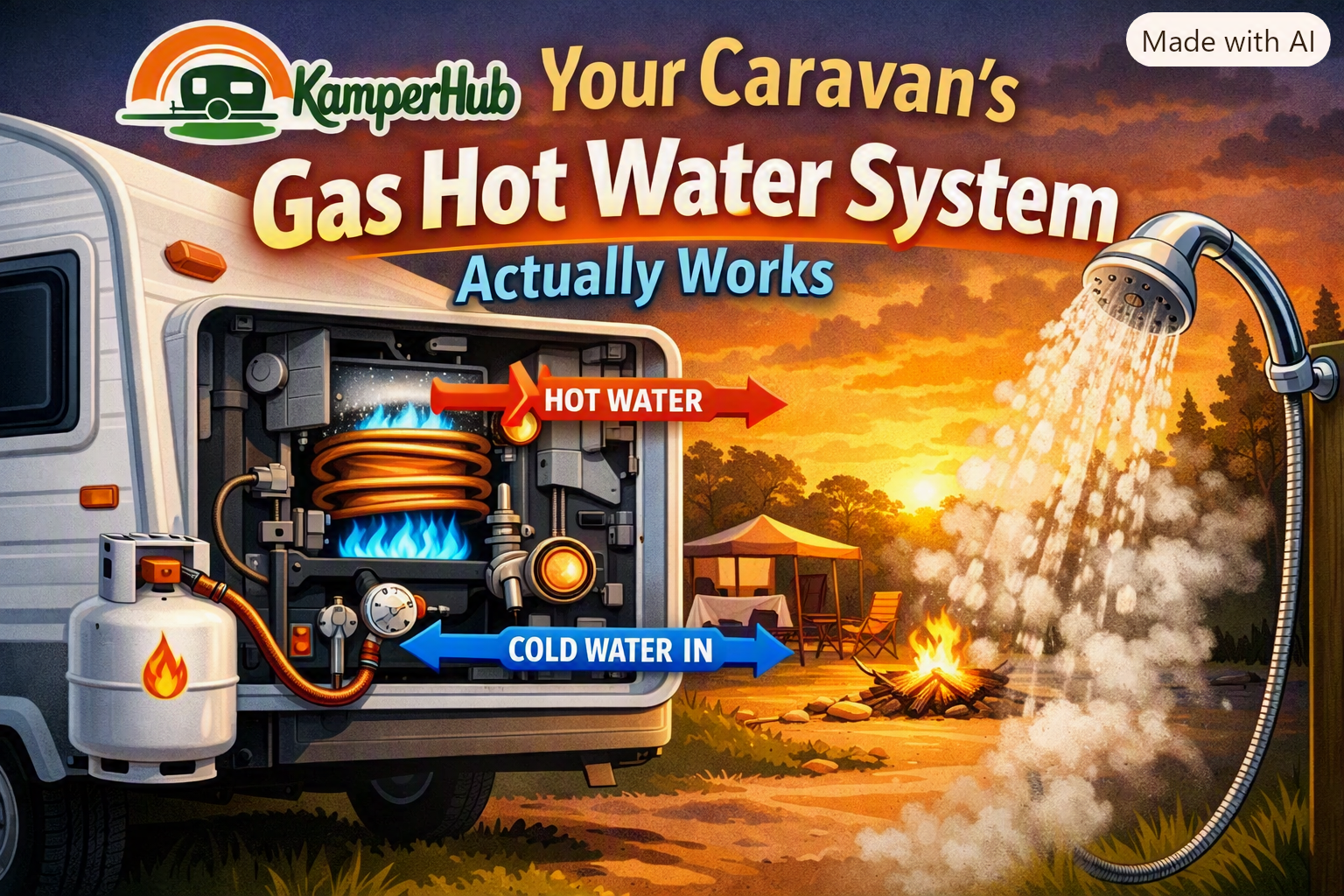
How Your Caravan's Gas Hot Water System Actually Works (And Why the Pump Stays On)
Someone asked us this exact question on Facebook this week, heading off on their first free camp in a Jayco Discovery: do I leave the water pump switched on all the time, or turn it on only when I want hot water — and are both my tanks actually plumbed into the hot water system?
If you're new to free camping, this trips up almost everyone in the first week. Here's how it actually works.
The pump: leave it switched on
Your caravan's water pump is a demand pump — it's pressure-activated, not a tap you turn on and off. Leave the pump switch on the whole time you're camped. When you open any tap (hot or cold), the drop in line pressure tells the pump to start pushing water through; close the tap and it stops again a second or two later.
You don't need to flick the pump on before a shower and off again afterwards. In fact, switching it off between uses is one of the more common things first-timers do that just adds an extra step for no benefit — the pump only draws power and pumps water when a tap is actually open.
The one time it's worth switching off: if you're leaving the van unattended for a while (day trip, overnight in town) and you're not 100% sure there isn't a slow leak somewhere in the system. A pump left on against an open leak will empty your tank into the bilge, not into a tap.
How the gas hot water service actually heats the water
Planning your next road trip?
KamperHub helps you plan routes, track weights, and travel with confidence. Free to use — no credit card required.
Get Started FreeMost caravan hot water services (Suburban, Truma and similar) work like this:
- You open a hot tap.
- The pump senses the pressure drop and starts pushing water through the system.
- Water flowing through the heater triggers a flow switch or micro switch inside the unit.
- That switch fires the gas ignition (piezo spark or electronic igniter, depending on your model) and opens the gas valve.
- The burner heats the water as it flows past, and it comes out the tap warm a few seconds later.
That's why hot water always takes a moment to arrive after you open the tap — the system has to sense flow, ignite, and heat before warm water reaches the outlet. It's normal, not a fault.
Two things to check before you rely on it heading off-grid:
- Gas bottle valve open, and the appliance's own gas isolation tap (usually a small lever near the HWS) turned on. Both need to be open — the bottle valve alone isn't enough if the appliance tap was left shut after servicing or storage.
- Never run the gas hot water service (or any gas appliance) while the van is being towed. It's a well-established towing safety rule across Australian caravan parks and manufacturers' own manuals — gas appliances get switched off before you hit the road, hot water included.
If your model has a gas/electric switch, running on 240V mains electric element instead of gas is the way to go whenever you've got power — most vans left plugged in overnight will have hot water ready by morning without touching the gas at all. Off-grid, gas is your only option, which is exactly why it's worth understanding before you're relying on it.
Twin tanks: check for a selector tap first
Having two water tanks doesn't usually mean both are feeding the system at once. Most twin-tank Jayco setups (and most other brands) have a selector tap — a small lever or ball valve under the van, near where the tanks sit — that lets you choose which tank the pump draws from.
Before you head off, get under the van and find it. You're looking for:
- A single lever/tap with two (or three) positions, usually labelled or colour-coded
- Lines running from each tank converging at that point before continuing to the pump
Practically, this means you run one tank down, then flick the selector to bring the second tank online — rather than both draining evenly together. It's worth knowing which position is "tank 1" and which is "tank 2" before you're down to your last few litres and guessing under the van in the dark.
A minority of setups plumb both tanks into a shared manifold with no selector, so they do drain together — if you can't find a lever, that's likely what you've got. When in doubt, your owner's manual (or a quick look at the plumbing diagram, if one came with the van) will confirm which system you have, since it does vary by build year and floor plan.
Quick pre-trip checklist for first-time free campers
- [ ] Water pump switch is on before you leave the last town with mains water
- [ ] Both tanks topped up, and you know which one the selector is drawing from
- [ ] Gas bottle valve open + HWS gas isolation tap open
- [ ] Gas hot water tested at home before you go — don't discover an ignition fault 200km from the nearest servo
- [ ] Gas switched off again before you drive anywhere
None of this is complicated once you've done it once — it's just the kind of thing nobody explains until you ask. Have a great first trip.
Join the Conversation
Found this helpful? Try KamperHub — it's free
Weight tracking, trip planning, and towing compliance — all in one app.
KamperHub Team
Helping travellers tow safely and confidently. KamperHub provides tools for trip planning, weight compliance, and adventure management.
Plan Your Next Caravan Adventure with KamperHub
Trip planning, weight tracking, fuel management, and more. Everything you need for safe and confident towing.
Get Started Free