
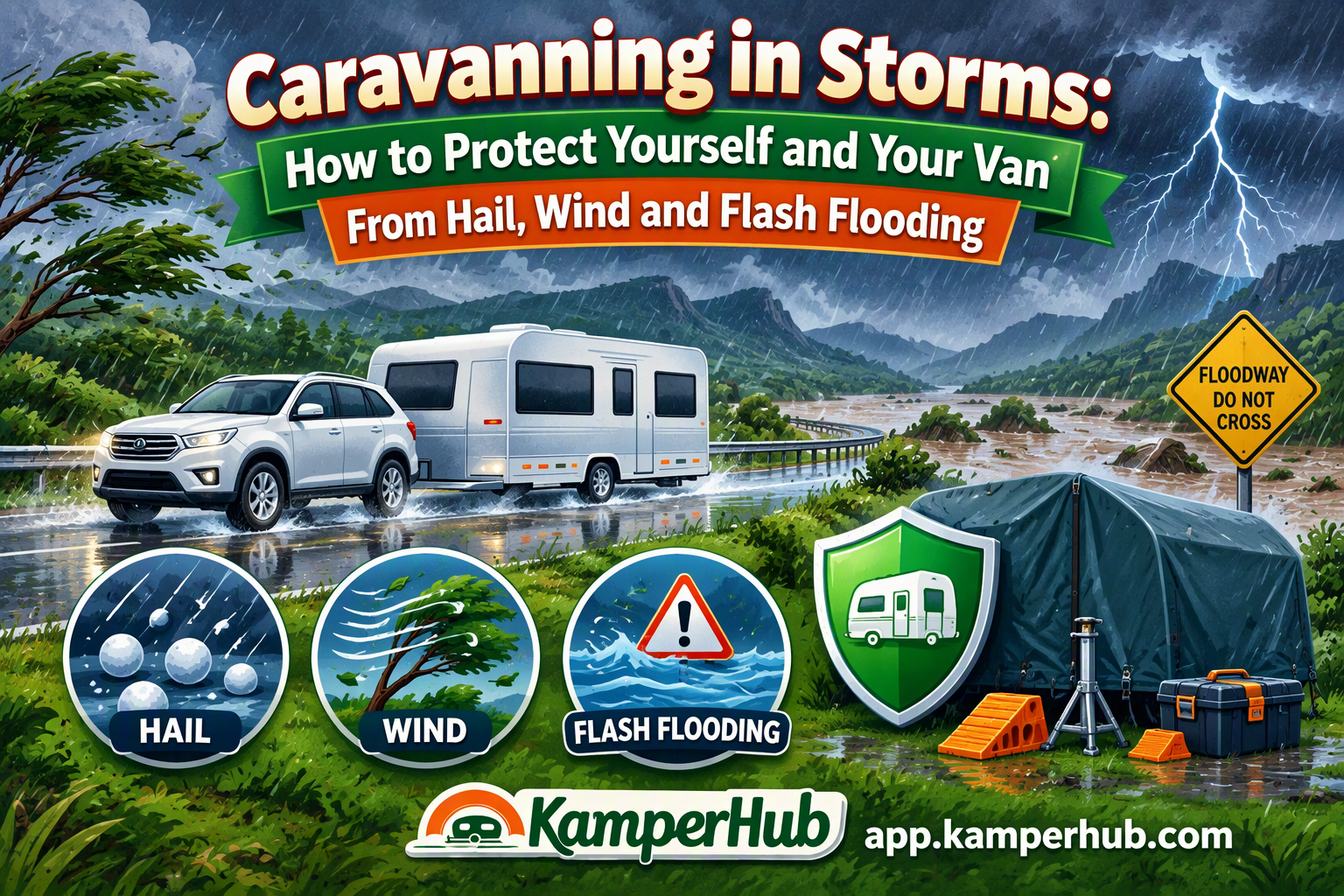
Caravanning in Storms: How to Protect Yourself and Your Van From Hail, Wind and Flash Flooding
"How Do You Protect Yourself and the Van When a Storm Hits?"
That question landed in a caravanning group this week, from a couple about to hit the road for the first time. With big hail, damaging winds and flash flooding hitting much of Australia this summer, it's a fair question. The first time you hear a storm on an aluminium roof at 2am, you realise how thin a caravan wall really is.
Here's the honest answer from people who've sat through a few: most of what keeps you safe happens before the storm arrives. Hail covers and tie-downs help, but the travellers who come through without damage are usually the ones who watched the forecast, picked a sensible site and had a plan.
This guide covers all of it: before you go, the day a storm is forecast, and what to do when one hits.
1. Know What "Severe" Actually Means
Planning your next road trip?
KamperHub helps you plan routes, track weights, and travel with confidence. Free to use — no credit card required.
Get Started FreeThe Bureau of Meteorology (BOM) issues a Severe Thunderstorm Warning when a storm is likely to bring one or more of:
- Damaging wind gusts of 90 km/h or more
- Large hail of 2 cm or more across (giant hail is 5 cm or more)
- Heavy rain that may lead to flash flooding
- Tornadoes
Any one of those can damage a caravan. Hail dents roofs and cracks hatches and skylights. Wind rips out awnings and brings down branches. Flash flooding can trap or float a van that's parked in the wrong spot.
2. Set Up Your Warnings Before You Leave Home
Don't rely on phone reception and a quick look at the sky.
- Bookmark KamperHub's Emergency Warnings page: app.kamperhub.com/emergency. It puts tap-to-call 000 and the SES, the BOM warnings and every state's fire, flood and storm warning site in one place. It's free and works without signing in. Tap the star on the ones for the states you travel in and they sit at the top.
- Install the BOM Weather app and turn on warning notifications for your current location, not just your home town.
- Install the emergency app for each state you'll pass through: Hazards Near Me (NSW), VicEmergency (VIC), Emergency WA, Alert SA, TasALERT, and your state's disaster dashboard in Queensland and the NT.
- Carry a battery-powered or wind-up AM/FM radio. Local ABC radio is the official emergency broadcaster, and it keeps working when mobile networks are overloaded or out.
- Save the numbers: 000 for life-threatening emergencies, and the SES on 132 500 for storm and flood help.
3. Pick Your Site Like a Storm Is Coming
You can't move a tree, but you can choose where you park.
- Look up. Don't park under large gum trees, especially river red gums, which are known for dropping big limbs without warning, even on calm days. A falling branch does more damage than hail.
- Look down. Never camp in a dry creek bed, on a low riverbank or at the bottom of a slope. Flash floods can arrive from rain that fell far upstream.
- Know your way out. Before dark, check how you'd leave if you had to, and whether that road crosses a causeway that could go under.
- Ask the park manager. Many caravan parks have a storm plan and a solid amenities block or camp kitchen you can shelter in. Find out where it is before you need it.
4. Hail Protection: What Actually Works
This is where people ask about gear. Some honest points:
- A standard caravan cover is not a hail cover. Ordinary storage covers protect against sun, dust and bird droppings. They won't stop a 3 cm hailstone. Purpose-made hail covers have a thick padded layer, and they cost and weigh much more.
- Hail covers suit storage and long stays more than touring. Fitting one to a full-size van takes two people and around 20–30 minutes. That isn't practical when you're moving every second day, but it's worth it when you're parked for weeks in a hail-prone area.
- Improvise if you must. Doonas, blankets, foam camping mats or a spare tarp tied over the roof hatches and front windows can save the most vulnerable parts. Hatches, skylights and the front window usually break first.
- Shelter is better than any cover. If a big storm is forecast, many caravan parks, showgrounds and some service stations will let you shelter under a carport or awning for a few hours. Ring ahead. Hardware store and shopping centre undercover car parks usually have height limits too low for a caravan, so check the clearance before you drive in.
- Protect your other gear. Roof-mounted solar panels and Starlink dishes take a hammering too. A padded or silicone cover on the dish is cheap insurance.
5. Wind: The Awning Is the First Thing to Go
Wind damage claims are often about awnings, not the van itself.
- Roll the awning in before the storm, not during it. A gust front can arrive minutes before the rain, and you don't want to be wrestling a flogging awning in the dark. If you're leaving camp for the day, roll it in.
- If you leave an annex up, peg it properly with heavy-duty pegs and tie-down straps, and drop one end slightly so rain runs off rather than pooling.
- Point the nose into the wind if you can. A van side-on to strong wind catches far more of it.
- Stow everything loose. Chairs, tables, mats and the BBQ become missiles.
- Leave the jockey wheel down and the stabilisers on, and keep the van hitched to your car if the site allows. The extra weight and stability help.
6. Should You Tow Through It?
Usually, no. Strong crosswinds and gusts are a common trigger for caravan sway, and heavy rain cuts visibility and grip. If a severe thunderstorm warning covers the road ahead:
- Wait it out. Pull into a town, a roadhouse or a caravan park and let it pass. Most storms move through within an hour or two.
- If you're caught out, slow down early, keep both hands on the wheel and pull off somewhere safe and clear of trees. Don't stop under a bridge in a flood-prone gully.
- Never drive into floodwater. "If it's flooded, forget it." It's the most common cause of flood deaths in Australia, and a caravan acts like a sail in moving water.
7. When the Storm Hits
- Get away from the van if the warning is serious. A solid brick amenities block or building is safer than any caravan in giant hail, destructive winds or a tornado warning.
- For lightning, a hard-top car is a better refuge than a tent or annex. Close the windows, keep your hands off metal parts, and don't park under trees.
- Inside the van, stay away from windows and hatches, and keep shoes on in case of broken glass or acrylic.
- Switch off gas appliances and close the gas bottles if strong winds or flooding are coming.
- Keep your phones charged and have a torch, water and your medications in one grab bag by the door.
8. Insurance: Check Before You Need It
- Read your policy for hail, storm and flood cover, and check whether "flood" is defined differently from "storm" in your policy. That definition matters.
- Take dated photos of your van now, especially the roof. Pre-existing dents are much easier to argue about when you have photos.
- Know your excess and whether the policy covers your contents and annex, not just the van.
- After a storm, photograph the damage before you touch anything, then make the van watertight to stop further damage. Most policies expect you to do that.
9. Your Storm Plan Checklist
Print this, or add it to your pre-departure list:
- [ ] BOM Weather app + state emergency apps installed, alerts on
- [ ] Battery or wind-up radio packed
- [ ] 000 and SES 132 500 saved
- [ ] Emergency Warnings page bookmarked, your states starred
- [ ] Insurance policy checked for hail, storm and flood
- [ ] Dated roof and body photos taken
- [ ] Heavy-duty pegs + awning tie-downs packed
- [ ] Grab bag ready: torch, water, medications, phone charger, documents
- [ ] Each night: no big trees overhead, not in a creek bed, exit route known
- [ ] Storm forecast: awning in, loose gear stowed, nearest solid shelter located
The Short Version
Watch the warnings, park away from trees and water, get the awning in early, don't tow into a storm, and when it's serious, get out of the van and into something solid. Most travellers who've sat through a big storm will tell you they were scared, but they were fine because they'd done the boring prep beforehand.
Have you been caught in a big storm on the road? Tell us what you learned on the KamperHub Facebook page. Your story might save someone else's van.
Join the Conversation
Found this helpful? Try KamperHub — it's free
Weight tracking, trip planning, and towing compliance — all in one app.
KamperHub Team
Helping travellers tow safely and confidently. KamperHub provides tools for trip planning, weight compliance, and adventure management.
Plan Your Next Caravan Adventure with KamperHub
Trip planning, weight tracking, fuel management, and more. Everything you need for safe and confident towing.
Get Started Free