
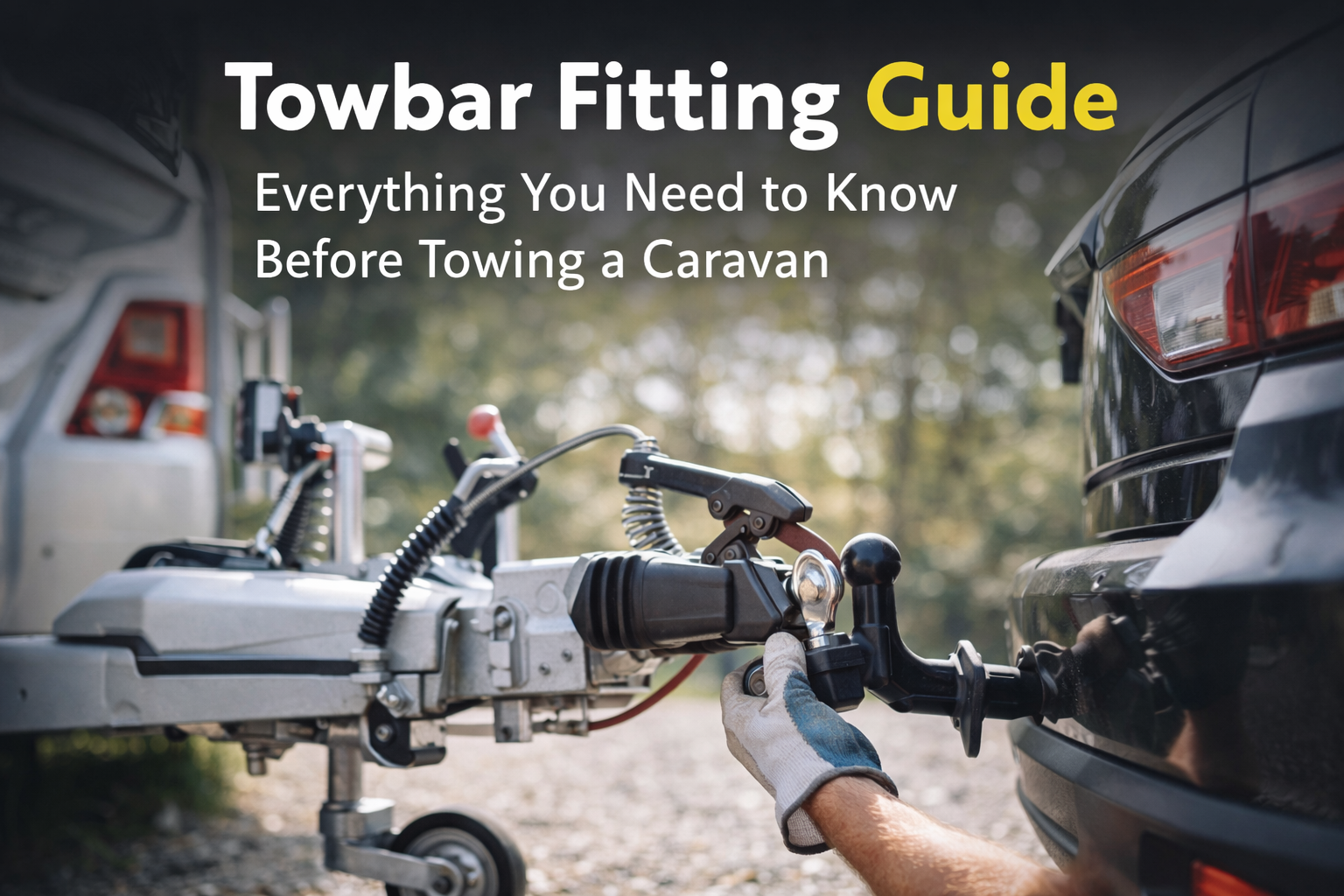
Towbar Fitting Guide: Everything You Need to Know Before Towing a Caravan
First Caravan? You Need the Right Towbar
So you've bought (or you're about to buy) your first caravan. Before you can hit the road, you need a towbar fitted to your tow vehicle — and getting this right from the start will save you headaches, money, and potentially a dangerous situation on the highway.
This guide covers everything you need to know about towbar fitting in Australia.
Types of Towbar
Planning your next road trip?
KamperHub helps you plan routes, track weights, and travel with confidence. Free to use — no credit card required.
Get Started FreeNot all towbars are created equal. Here are the main types you'll come across:
Standard Tongue Towbar
The most common type in Australia. A flat mounting plate with a hitch receiver that accepts a towball or weight distribution hitch.
- Pros: Versatile, accepts different hitch types, easy to swap towball sizes
- Cons: Towball sticks out when not towing (unless you remove it)
- Best for: Most caravan towing situations
Heavy-Duty Towbar
A beefier version of the standard, designed for higher-rated towing capacity.
- Pros: Higher weight ratings, more robust construction
- Cons: Heavier, more expensive
- Best for: Larger caravans, off-road towing
Combination Towbar
Includes both a standard hitch receiver and a pintle hook mount.
- Pros: Multiple towing options
- Cons: More complex, generally heavier
- Best for: People who tow different trailer types
Weight Ratings — The Critical Numbers
This is where it gets serious. Every towbar has weight ratings that must not be exceeded.
Key ratings to check:
- Towing capacity: The maximum weight the towbar can pull. This must match or exceed your caravan's ATM (Aggregate Trailer Mass — the maximum loaded weight of the caravan)
- Towball download: The maximum vertical weight pressing down on the towball. Typically 10% of the towing capacity, or as specified by the vehicle manufacturer
- Vehicle towing capacity: Your vehicle has its own towing limit (check the owner's manual or compliance plate). The towbar rating AND the vehicle rating both apply — you're limited by whichever is lower
Example: Your vehicle is rated to tow 3,500kg and your towbar is rated at 3,500kg, but your caravan's ATM is 2,800kg. You're fine. But if your towbar is only rated at 2,200kg, that's your limit — not the vehicle's 3,500kg.
Important: In Australia, all towbars must comply with AS 4177 (the Australian Standard for towbar and coupling assemblies). Make sure your fitter supplies a compliance plate.
Electrical Connections
Your caravan needs electrical connections for road lights, indicators, brakes, and often interior systems. Getting the right plug is essential.
7-Pin Flat (Australian Standard)
The basic Australian trailer plug. Handles road lights, indicators, and electric brakes.
- Suitable for most caravans
- Widely available and standard across Australia
- Does NOT provide power for charging the caravan's house battery
12-Pin Flat
The full-featured Australian caravan plug. Everything a 7-pin does, plus:
- Charges the caravan leisure battery while driving
- Powers the caravan fridge on 12V while towing
- Reverse light signal
Our recommendation: If you're towing a caravan (not just a box trailer), get a 12-pin flat socket installed. The extra connections are worth it.
Anderson Plug
A heavy-duty 50A connector, often installed alongside the 7 or 12-pin plug specifically for high-current battery charging. Common on off-road and touring setups.
Vehicle-Specific vs Universal Wiring
This is an important distinction that many people miss.
Vehicle-specific (dedicated) wiring:
- Designed for your exact vehicle make and model
- Connects properly to the vehicle's CAN bus computer system
- Won't throw up dashboard warning lights or error codes
- More expensive but the right way to do it
Universal wiring:
- One-size-fits-all approach
- Cheaper but can cause electrical issues with modern vehicles
- May trigger warning lights on newer cars with advanced electronics
For any vehicle built after 2010, we strongly recommend vehicle-specific wiring.
What to Ask Your Towbar Fitter
Before you book, ask these questions:
- Is the towbar ADR-compliant and rated for my towing needs? Get the specific towing and towball download ratings
- Do you supply a compliance plate? This is legally required in Australia
- Do you fit vehicle-specific or universal wiring? You want vehicle-specific
- What plug type will be installed? Ask for 12-pin flat for caravan towing
- What's the warranty? Most reputable fitters offer 3-5 years
- Will it affect my vehicle warranty? If your vehicle is still under manufacturer warranty, check with your dealer first
- Do you fit weight distribution hitches? If you're towing a heavy van, you may need one from day one
Where to Get a Towbar Fitted in Australia
- Vehicle dealerships — some offer towbar fitting as an option, keeps everything under one warranty
- Specialist towbar fitters — Hayman Reese, Trailboss, and Hitch'n'Go are well-known brands
- 4WD and caravan accessory shops — ARB, Opposite Lock, Caravan RV Camping
- Auto electricians — for wiring upgrades or adding Anderson plugs to existing setups
Always check reviews and ask other caravan owners for recommendations. Word of mouth is usually the best guide.
Budget Guide (2026 Australian Prices)
| Item | Approximate Cost |
|---|---|
| Standard towbar (supply + fit) | $500 - $900 |
| Heavy-duty towbar (supply + fit) | $800 - $1,500 |
| 12-pin wiring (vehicle-specific) | $200 - $400 |
| Anderson plug addition | $80 - $150 |
| Weight distribution hitch | $500 - $1,200 |
Prices vary by vehicle and location. Get at least two quotes.
Common Mistakes to Avoid
- Buying the cheapest towbar — if it's not rated for your caravan, it's dangerous and illegal
- Skipping the 12-pin upgrade — you'll regret it when your fridge isn't running while towing
- Ignoring towball download limits — exceeding this causes steering instability and tyre wear on the tow vehicle
- Not checking vehicle GCM — your Gross Combined Mass (vehicle + caravan + everything inside both) has a legal limit. The towbar is only one piece of the puzzle
- DIY wiring without experience — incorrect wiring can damage your vehicle's electronics. Get it done properly
The Bottom Line
A good towbar fitted correctly is the foundation of safe towing. Don't cut corners — get the right type, the right rating, and proper vehicle-specific wiring. Your caravan, your vehicle, and everyone on the road will thank you.
Need help checking if your vehicle can safely tow your caravan? [KamperHub's weight compliance tools](https://app.kamperhub.com/tools) calculate your GVM, GCM, and towball weight so you know you're legal before you leave the driveway.
Related Guides
- How to Choose the Right Tow Vehicle for Your Caravan
- Caravan Weight Compliance Explained: A Beginner's Guide
- Caravan Electric Brake Wiring: Diagnose and Fix Common Problems
- The Ultimate Caravan Pre-Departure Checklist
Useful Resources
Join the Conversation
Found this helpful? Try KamperHub — it's free
Weight tracking, trip planning, and towing compliance — all in one app.
KamperHub Team
Helping travellers tow safely and confidently. KamperHub provides tools for trip planning, weight compliance, and adventure management.
Plan Your Next Caravan Adventure with KamperHub
Trip planning, weight tracking, fuel management, and more. Everything you need for safe and confident towing.
Get Started Free