
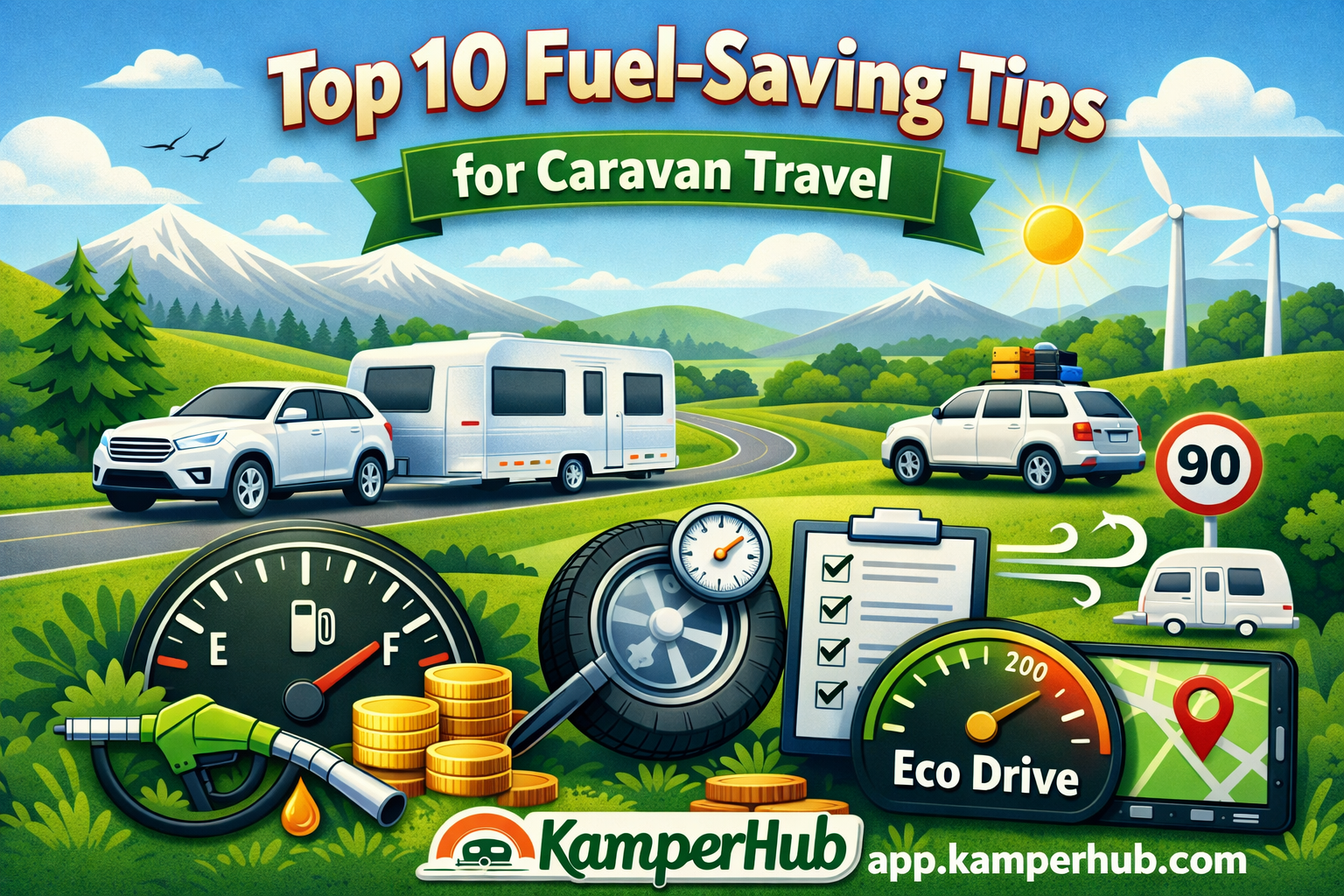
Top 10 Fuel-Saving Tips for Caravan Travel
Why Fuel Matters More When You're Towing
Towing a caravan can increase your fuel consumption by 30-50% compared to driving solo. On a long trip, that adds up fast. A vehicle that normally uses 10L/100km might blow out to 15L/100km or more with a 2-tonne caravan behind it.
The good news? There are proven ways to bring that number down without sacrificing your trip. Here are our top 10 tips for saving fuel on the road.
1. Check Your Tyre Pressures Before Every Drive
Planning your next road trip?
KamperHub helps you plan routes, track weights, and travel with confidence. Free to use — no credit card required.
Get Started FreeUnder-inflated tyres create more rolling resistance, which means your engine works harder. Check both your tow vehicle and caravan tyres before every driving day. Use the manufacturer's recommended pressures for loaded conditions — not the cold pressure on the placard.
Pro tip: Invest in a quality digital tyre gauge. The cheap pencil-style ones can be off by 5+ PSI.
2. Slow Down — Seriously
This is the single biggest fuel saver. Aerodynamic drag increases exponentially with speed. Dropping from 110km/h to 100km/h can reduce fuel consumption by 10-15% when towing. At 90km/h, the savings are even greater.
Most experienced towers will tell you: 90-95km/h is the sweet spot for fuel economy, safety, and still making good time.
3. Reduce Your Weight
Every extra kilogram costs fuel. Before you leave, ask yourself: do I really need it? Common culprits include:
- Full water tanks (fill up at your destination instead)
- Too much firewood
- Duplicate tools and equipment
- "Just in case" items that never get used
A 200kg weight reduction can save 1-2L/100km over a long trip.
4. Use Cruise Control on Flat Roads
Constant speed is more fuel-efficient than the speed variations that come with manual throttle control. Use cruise control on flat, open highways. But turn it off in hilly terrain — cruise control tends to accelerate hard uphill, which wastes fuel.
5. Plan Your Fuel Stops
Running on fumes and pulling into the first servo you see often means paying premium prices. Plan your fuel stops in advance using apps like KamperHub's route planner, which shows fuel stations along your route. Fill up at larger towns where competition keeps prices lower.
Bonus: Filling up in the morning when fuel is cooler means slightly denser fuel — you get marginally more energy per litre.
6. Maintain Your Vehicle
A well-maintained engine runs more efficiently. Before a big trip:
- Replace air filters (a clogged filter restricts airflow)
- Check spark plugs (diesels: check injectors)
- Use the correct oil grade
- Ensure your cooling system is working properly
A poorly maintained engine can use 10-20% more fuel than a well-tuned one.
7. Reduce Aerodynamic Drag
Your caravan is already a big wind block, but you can minimise extra drag:
- Remove roof racks and roof boxes from your tow vehicle when not needed
- Keep windows and sunroofs closed at highway speed
- Consider a wind deflector on the roof of your tow vehicle
- Pack items inside the caravan, not on external racks
Even bike racks add measurable drag. If you're not using them on a particular leg, take them off.
8. Drive Smoothly
Aggressive acceleration and hard braking waste fuel. Instead:
- Accelerate gently from stops
- Look ahead and anticipate traffic flow
- Coast to a stop rather than braking late
- Use engine braking on descents rather than riding the brake
Smooth driving also reduces wear on your brakes, tyres, and transmission — saving money beyond just fuel.
9. Fill Up Where Fuel Is Cheap
Fuel prices in Australia vary dramatically by location. As a general rule:
- Cheapest: Large regional towns, outer suburbs
- Mid-range: Small towns on major highways
- Most expensive: Remote areas, tourist towns, last-chance servos
Apps like FuelCheck (NSW), FuelWatch (WA), and GasBuddy can help you find the cheapest fuel near your route.
10. Consider Your Driving Times
Driving in peak traffic means stop-start conditions, which hammers fuel economy. Try to:
- Leave early to avoid city traffic
- Drive through major towns outside peak hours
- Take bypasses where available
- Rest during the middle of the day and drive mornings/evenings
Less time idling in traffic means more kilometres per litre.
The Bottom Line
You don't need to do all 10 at once. Even applying 3 or 4 of these tips consistently can save you hundreds of dollars over a multi-week trip. The biggest wins are speed reduction, weight reduction, and tyre pressures — start there and build the rest into your routine.
Happy (and efficient) travels!
Plan Your Trip with KamperHub
KamperHub's caravan trip planner calculates fuel costs, finds free camping spots, generates packing lists, and manages trip budgets — all in one app. Free to use.
Useful Resources
Join the Conversation
Found this helpful? Try KamperHub — it's free
Weight tracking, trip planning, and towing compliance — all in one app.
KamperHub Team
Helping travellers tow safely and confidently. KamperHub provides tools for trip planning, weight compliance, and adventure management.
Plan Your Next Caravan Adventure with KamperHub
Trip planning, weight tracking, fuel management, and more. Everything you need for safe and confident towing.
Get Started Free