
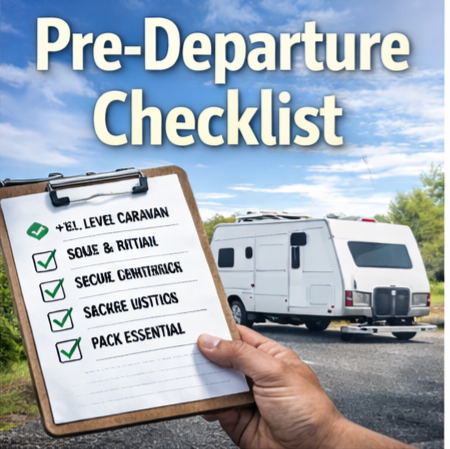
The Ultimate Travel Trailer Pre-Departure Checklist: Don't Leave Without Checking These
It doesn't matter if you've hitched up five times or five hundred times — the moment you skip a step is the moment something goes wrong. We've all heard the stories: the bloke who drove off with the stabiliser legs down, the couple who forgot to latch a roof hatch and found their bedding scattered across the highway, or the family whose travel trailer separated from the vehicle because the coupling wasn't properly locked. These aren't urban legends. They happen, and they happen to experienced tourers who got complacent.
A pre-departure checklist isn't a beginner's crutch. It's a professional habit. Pilots use checklists before every flight, regardless of how many thousands of hours they've logged. Surgeons use checklists before every operation. If those professionals don't trust their memory, neither should we.
This checklist is designed to be worked through methodically, section by section. Print it out, laminate it, stick it on the inside of your travel trailer door. Run through it every single time. It takes ten minutes and it could save your life.
Before You Hitch
Start with the basics before you even think about connecting the travel trailer to the vehicle. These are the items that need attention while the van is still standing on its own.
Check tire pressures on the travel trailer. This is first because it's the most commonly skipped — and one of the most important. Don't just inflate to the number on the sidewall. That's the maximum pressure, not necessarily the correct pressure for your load. Your ideal pressure depends on your actual loaded weight, tire size, and load rating. If you're unsure, err on the side of the manufacturer's recommendation for your axle load. Check pressures when the tires are cold — before you've driven anywhere.
Check tire pressures on the tow vehicle. Your vehicle's tire pressures also need adjusting for towing. Most manufacturers specify a higher rear pressure when towing. Check your vehicle's placard or owner's manual for the towing-specific pressures. Running standard pressures while towing puts extra stress on the rear tires and affects handling.
Torque your wheel nuts. This catches people out, especially after a tire change or service. Wheel nuts should be torqued to the manufacturer's specification — typically around 120 to 130 Nm for most travel trailer wheels, but check your specific van. A torque wrench is a worthwhile investment. Re-torque after the first 50 to 100 kilometers of any trip where wheels have been removed.
Test all lights. Turn on your vehicle's headlights, then walk around the travel trailer checking tail lights, brake lights, indicators, and reverse lights. Get someone to press the brake pedal and flick the indicators while you watch. A blown globe is a simple fix in the driveway — it's a lot harder on the side of the road and could earn you a defect notice.
Check the breakaway cable and safety chains. Make sure the breakaway cable is intact, not frayed, and the pin pulls freely from the switch. The safety chains should be in good condition with no damaged links. You'll connect these during coupling, but check them now while you can see them clearly.
Release the handbrake. Sounds obvious, but towing with the travel trailer handbrake on is more common than you'd think. It'll cook your brake shoes in kilometers and you might not notice until you smell burning or see smoke.
Raise the jockey wheel completely. Wind it all the way up and lock the clamp. A jockey wheel that drops while driving will hit the road, destroy itself, and potentially rip the mounting bracket off the drawbar. If your jockey wheel has a swivel function, make sure it's locked in the upright position.
Retract all stabiliser legs. Walk around and check every corner. They should be fully wound up and secured. A dragging stabiliser leg on bitumen throws sparks and wears through in seconds. On a roundabout, a forgotten leg can catch the road surface and cause a serious incident.
Close all external hatches, vents, and storage doors. Check every external door and compartment. Push on each one to confirm it's latched — don't just look. Wind-pressure at highway speed can pop open a compartment that looks closed but isn't properly latched.
Lower the antenna. If you have a roof-mounted TV antenna, make sure it's fully down. Trees, bridges, and service station canopies don't forgive a raised antenna. This is one of the most common (and expensive) mistakes RVers make.
Retract the entry step. Electric steps should retract automatically when the door closes, but check anyway. Manual steps need to be folded up and secured. A step dragging on the road is noisy, throws sparks, and destroys itself quickly.
The Coupling
Planning your next road trip?
KamperHub helps you plan routes, track weights, and travel with confidence. Free to use — no credit card required.
Get Started FreeThis is the critical safety section. A properly coupled travel trailer is solidly connected to your vehicle at multiple points. Rushing this section is how separations happen.
Lower the travel trailer onto the tongue weight and lock the coupling. The coupling handle should click fully into the locked position. Give the handle a firm tug to confirm it's engaged. If your coupling has a safety clip or pin, insert it now. Never assume the coupling is locked — always verify physically.
Attach the safety chains. Cross the chains under the coupling in an X pattern. This serves two purposes: it catches the drawbar if the coupling fails, and crossing them creates a cradle that prevents the drawbar from hitting the road. The chains should have enough slack to allow full turning but not so much that they drag on the ground. Use rated shackles, not random bolts.
Connect the breakaway cable. Attach the breakaway cable to the vehicle — specifically to the towbar or a designated attachment point on the vehicle, not to the coupling itself. If the coupling fails, you need the breakaway cable to pull the pin and activate the travel trailer's brakes independently. If you attach it to the coupling, it'll separate along with everything else and do nothing.
Plug in the 12-pin connector. Push it in firmly and make sure it clicks. A loose connection causes intermittent lights, which other drivers interpret as brake lights flickering — or worse, no brake lights at all. After connecting, test the lights again: indicators left and right, brake lights, tail lights, and reverse lights.
Test the electric brakes. Pull away slowly — just walking pace — and use the brake controller's manual override to apply the travel trailer brakes. You should feel the travel trailer pulling back against the vehicle. If you feel nothing, stop immediately and troubleshoot. Common causes are a blown fuse, a loose plug connection, or a brake controller that's lost its settings. Never tow without working electric brakes.
Check the weight distribution hitch if you have one fitted. The bars should be tensioned correctly, with the vehicle sitting level or close to it. An improperly adjusted WDH can actually make handling worse than no WDH at all. The front of the tow vehicle should not be noticeably higher than normal.
Inside the travel trailer
The inside of your travel trailer needs to be travel-ready. Things move, fall, break, and spill when you're underway — especially on rough roads.
Switch the fridge to 12V operation. If your fridge has been running on 240V while connected to mains power, switch it to 12V or auto mode before departure. Turn off the gas supply to the fridge — you should never travel with gas appliances running. Some travellers do run the fridge on gas while driving, but it's illegal in some states and poses a fire risk in an accident.
Close and latch every cupboard and drawer. Open each one and close it again, pressing until you hear the latch click. Cupboards that seem closed can pop open when the van flexes over bumps, launching tins, bottles, and crockery across the interior. Heavy items should be stored low and towards the centre of the van.
Secure loose items. Anything that isn't latched, strapped, or stowed will become a projectile. This includes fruit bowls, decorative items, bottles on benchtops, phones on charge, and anything else sitting on a flat surface. In a sudden stop, a coffee mug becomes a missile.
Turn off all gas bottles. Close the valves on every gas bottle. The only exception is if you're deliberately running the fridge on gas (and you've accepted the risks). Gas leaks in a sealed travel trailer are extremely dangerous.
Close and lock all windows. Including roof hatches and ventilation panels. Wind pressure at speed can rip a window open, damage the hinges, or send the flyscreen into the next postcode.
Turn off the water pump. If a fitting works loose while you're driving, a running water pump will empty your tank into the travel trailer floor. Turn it off and you'll contain any leak to whatever's in the lines.
Turn off the hot water system. Whether it's electric, gas, or both, switch it off for travel. There's no need to heat water while driving, and it eliminates a potential ignition source.
Check the bed and sleeping area. Heavy items stored on the bed (laptops, books, toolboxes) should be moved to the floor or a secure location. If your bed lifts for under-bed storage, make sure it's latched down.
The Vehicle
Your tow vehicle needs attention too. Towing puts extra demands on everything, and a few simple checks make a significant difference.
Adjust your mirrors. You need to see down both sides of the travel trailer and beyond. If your standard mirrors don't give you that visibility, fit towing mirror extensions. In most states, it's a legal requirement to be able to see behind the travel trailer. Adjust them now, while you're stationary — not while merging onto the highway.
Activate your tire pressure monitoring system. If you've got a TPMS fitted (and you should), make sure it's on and showing correct readings for all tires — vehicle and travel trailer. Check that the sensors are reporting and the display is receiving. A TPMS gives you early warning of a slow leak or overheating tire, which can prevent a blowout.
Set the brake controller gain. Your electric brake controller needs to be set for the weight you're towing. Too low and the travel trailer brakes barely work. Too high and they'll lock up. Start with the manufacturer's recommendation and fine-tune on your first few stops. The brakes should feel smooth and progressive, with the travel trailer slowing in proportion to the vehicle.
Check your fuel level. Know how far your first fuel stop is and make sure you've got enough to get there with a comfortable margin. Towing increases fuel consumption dramatically — often by 30 to 50 percent compared to driving unladen. If you normally get 700 kilometers from a tank, expect 400 to 500 while towing.
Accessible essentials. Make sure water bottles, snacks, sunglasses, phone charger, and toll tags are within reach. Rummaging through bags while driving (or worse, pulling over on a highway to find your sunnies) is avoidable with thirty seconds of preparation.
Check your driver's license. This sounds ridiculous, but if your combined vehicle and travel trailer weight exceeds certain limits, you may need a higher license class. In most states, a standard car license covers combinations up to 4,500 kg GCWR. If your rig exceeds this, you may need an LR license. Check before you drive, not at a roadside inspection.
The Final Walk-Around
This is your last chance to catch anything you've missed. Do a complete circuit of the entire rig — vehicle and travel trailer — walking slowly and looking at everything.
Start at the driver's door and walk clockwise around the vehicle. Check that nothing is hanging, dragging, or loose. Look under the vehicle for anything that shouldn't be there.
Continue around the front of the travel trailer. Check the coupling from the front — can you see the locking mechanism is engaged? Are the chains hanging correctly? Is the breakaway cable routed cleanly?
Walk down the nearside of the travel trailer. Check all compartment doors, windows, and hatches. Look at the tires — are they visually inflated correctly? Any obvious damage or bulging?
Check the rear of the travel trailer. Are the lights clean and visible? Is the number plate attached and legible? Is the spare tire secure (if rear-mounted)?
Walk up the offside and complete the circuit back to the driver's door. Check the same items on this side.
Look underneath. Crouch down and look under the travel trailer. Are the stabiliser legs fully up? Is anything hanging down that shouldn't be? Is the grey water outlet sealed?
Check clearance. If you're in a travel trailer park or campground, check your exit route. Can you clear the sites around you? Are there low branches, posts, or bollards in your path?
Disconnect and stow the power lead. If you've been on mains power, this is easy to forget. Unplug the lead from the power bollard first (to avoid a live connection dragging), then disconnect from the travel trailer and stow it in a compartment.
Final headcount. Is everyone in the vehicle? Kids, dogs, partners who wandered off to the amenities block? It sounds funny until it happens to you.
Building the Habit
The key to making this checklist work is using it every time without exception. Not just on the big trips — on the weekend overnighter too. Not just when you're feeling cautious — especially when you're rushing because you left late.
The items on this list take about ten minutes to work through. That's ten minutes against the hours you'll lose dealing with a flat tire from incorrect pressure, the cost of replacing a destroyed stabiliser leg, or the genuine danger of a coupling separation at highway speed.
If paper checklists aren't your style, KamperHub includes digital pre-departure checklists that you can customise for your specific setup and work through on your phone while you walk around the rig. You can add your own items, tick them off in order, and reset them for the next trip.
However you do it — paper, phone, or pure memory — the checklist is the single most important habit you can build as a RVer. Make it non-negotiable, and you'll never be the one telling the embarrassing story at the campfire.
Useful Resources
Join the Conversation
Found this helpful? Try KamperHub — it's free
Weight tracking, trip planning, and towing compliance — all in one app.
KamperHub Team
Helping travellers tow safely and confidently. KamperHub provides tools for trip planning, weight compliance, and adventure management.
Plan Your Next Caravan Adventure with KamperHub
Trip planning, weight tracking, fuel management, and more. Everything you need for safe and confident towing.
Get Started Free