
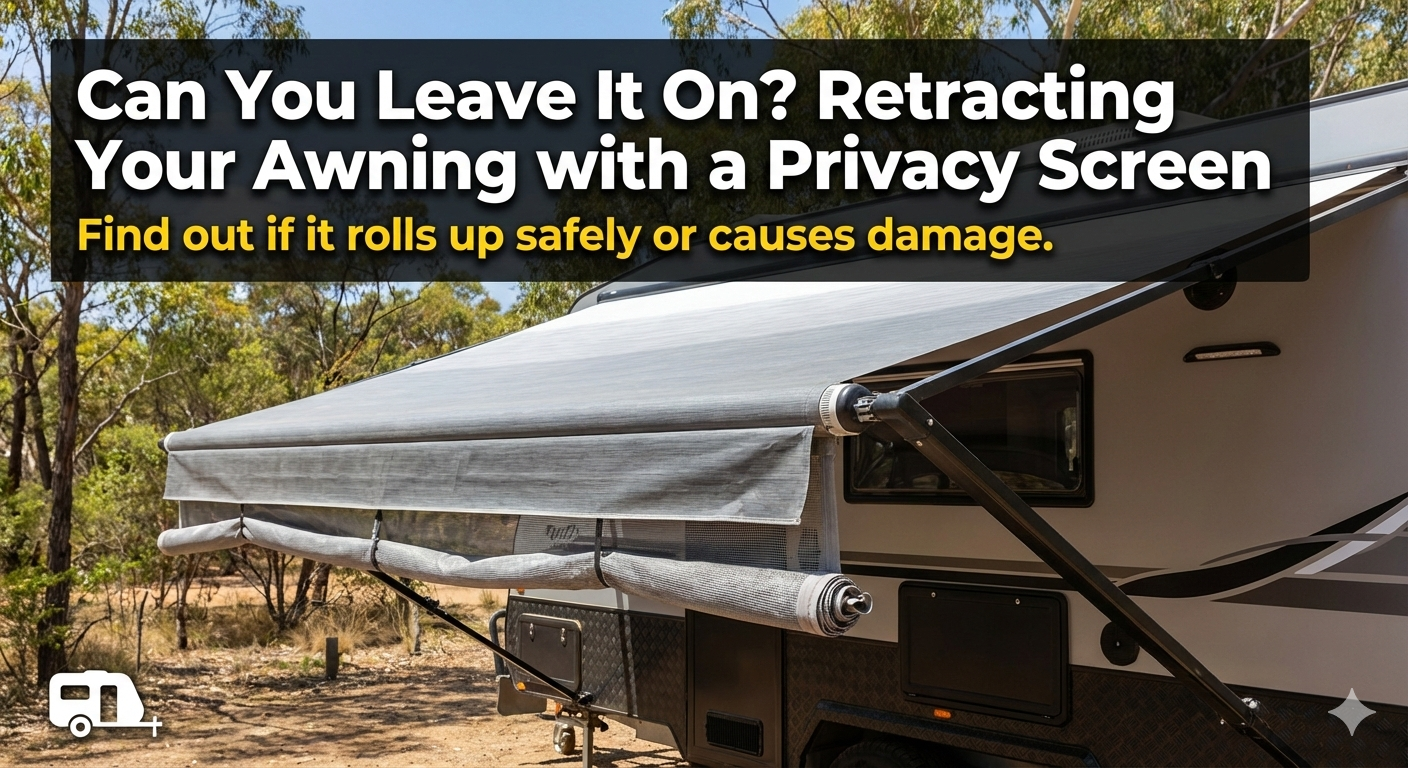
Can You Leave a Privacy Screen Attached When You Roll Up Your Travel Trailer Awning?
The Short Answer
No — you should remove your privacy screen before rolling up your awning. Most standard travel trailer privacy screens sold in the US are not designed to stay attached and retract with the awning. If you try to roll them up together, you risk damaging the awning mechanism, the screen, or both.
It might look like the screen would just wrap around the roller with the awning fabric, but there are good reasons why that does not work.
Why You Cannot Just Roll Them Up Together
Planning your next road trip?
KamperHub helps you plan routes, track weights, and travel with confidence. Free to use — no credit card required.
Get Started FreeExtra Bulk on the Roller
Privacy screens add significant material thickness to the roll. Your awning roller is engineered to handle the awning fabric alone. Adding a screen on top increases the diameter of the rolled-up bundle, which can prevent the awning from sitting flush against the travel trailer wall. On a box or cassette awning, the screen simply will not fit inside the housing.
Extra Weight
A quality privacy screen (typically 180–230 GSM fabric) adds several kilograms of material. For motorised awnings, this extra weight can exceed what the motor is rated to handle. Even on manual awnings, it puts unnecessary strain on the spring mechanism.
Uneven Rolling
The screen does not sit flat against the awning fabric when rolling. It bunches, folds unevenly, and creates lumps that can crease or permanently damage both the awning vinyl and the screen mesh.
Travel Risk
Even if you managed to roll them up together at camp, traveling with the extra bulk creates vibration and movement that can wear through the awning fabric. The screen's rope spline and attachment points can also rub and cause abrasion damage over time.
How Standard Privacy Screens Attach
Understanding how screens connect to your awning explains why they need to come off separately.
Most American travel trailer privacy screens use a rope spline (also called a bead cord) sewn into the top edge of the screen. This spline slides into the sail track — a channel running along the outer edge of the awning roller or the awning's lead rail.
To set up, you simply feed the spline into one end of the track and slide the screen along until it covers the area you want. Peg the bottom to the ground, tension it with the supplied guy ropes, and you are done.
To pack down, reverse the process — unclip, unpeg, slide the screen out of the track, fold it up, and stow it in its carry bag.
Spline Sizes Matter
Different awning brands use different track sizes:
| Awning Type | Typical Spline Size |
|---|---|
| Roll-out awnings (Dometic, Carefree) | 7 mm |
| Box/cassette awnings (Fiamma) | 5 mm |
Some screens come with a dual spline design (both 5 mm and 7 mm) so they fit either type. Check your awning brand before buying.
Making Setup and Packdown Faster
If the main frustration is the time it takes to put up and take down your screen, here are some practical tips:
Use an Anti-Flap Kit with Built-In Sail Tracks
An anti-flap kit (like the American Traveler AFK PRO) clamps along both sides of your awning to stop it flapping in the wind. The good ones have integrated sail tracks built into the rails, giving you extra channels to slide in privacy screens, end walls, or fly netting.
This means you can attach screens to the anti-flap kit rails instead of the awning roller track — making it quicker to add and remove screens without disturbing the awning itself.
Keep the Screen Pre-Folded for Quick Deployment
Rather than stuffing your screen into the carry bag in a ball, fold it lengthways with the spline edge on top. When you arrive at camp, you can feed the spline into the track in one smooth motion rather than untangling it first.
Use Velcro Straps or Clips for Quick-Release
Some travelers attach small velcro straps or spring clips along the bottom edge instead of pegging every point. This speeds up both setup and packdown, especially on hard ground where pegs are difficult.
Consider End Walls Separately
If you only need privacy on one side, a single end wall (the shorter screen that covers the open end of the awning) is much faster to put up and take down than a full-length side screen.
Types of Privacy Screens Available in the US
Standard Mesh Screens
The most common type. Made from woven polyethylene mesh (typically 180–230 GSM), they block 85–95% of sunlight and UV while still allowing airflow. They slide into the awning track and peg to the ground.
Best for: General privacy, sun protection, and light wind shelter while keeping airflow.
Popular brands: Carefree of Colorado, Dometic, Lippert, ShadePro
Sunblocker Walls
Solid or near-solid fabric walls that provide more weather protection than mesh screens. Less airflow but better rain and wind protection.
Best for: Cooler weather, rain protection, or creating a more enclosed outdoor space.
Popular brands: American Traveler Sunblocker range
Full Annexe Walls
Pre-made wall systems with windows, doors, and fly screens that fully enclose your awning space. These turn your awning area into a proper room.
Best for: Extended stays, cooler climates, or when you need a fully enclosed space.
End Walls / Drop-Down Screens
Shorter screens that cover just the open end(s) of the awning. Quick to set up and effective for blocking low-angle afternoon sun or wind from one direction.
Best for: Targeted privacy or sun protection without the hassle of full-length screens.
What to Look for When Buying
Fabric Weight (GSM)
Higher GSM means thicker, more durable fabric. For American conditions, aim for 180 GSM or above. Premium screens sit around 200–230 GSM.
UV Stabilisation
Essential in the US. UV-stabilized mesh will not degrade or fade under intense sun exposure. Cheaper screens without UV treatment will become brittle and tear within a season or two.
Shade Rating
Most quality screens offer 85–95% shade. A higher shade rating blocks more sun but also reduces airflow slightly.
Reinforced Edges
Look for lock-stitched or hemmed edges and reinforced corners. These are the stress points that fail first on cheaper screens.
Included Accessories
Better screens come with pegs, guy ropes, D-ring tie-downs, and a carry bag. Budget options may require you to supply your own.
Wind Safety Reminder
Privacy screens are not designed to handle strong winds. The general rule across American travel trailer forums is straightforward: "wind up, roll up."
- If winds exceed 15-20 mph, take the screen down and consider rolling up the awning too
- Never try to take down a screen or awning in very high winds — it can be snatched out of your hands and cause injury or serious damage
- If you are leaving your campsite for the day, take the screen down as a precaution
- Always peg the bottom of the screen securely — an unsecured screen acts like a sail and can pull your awning apart
Where to Buy in the US
| Retailer | Website |
|---|---|
| etrailer | etrailer.com |
| Camping World | campingworld.com |
| Amazon | amazon.com |
The Bottom Line
It is tempting to think the privacy screen would just roll up neatly with the awning — but it will not. The extra bulk, weight, and uneven rolling will damage your awning over time, and on box awnings it simply will not fit back into the cassette.
The good news is that with a bit of practice, sliding a screen in and out of the track becomes a two-minute job. Pair it with an anti-flap kit for even easier attachment, keep it folded neatly for quick deployment, and you will have camp set up in no time.
Heading out on the road? KamperHub helps you plan your travel trailer trips, manage your gear, and stay weight-compliant. [Start your free trial today](https://app.kamperhub.com).
Join the Conversation
Found this helpful? Try KamperHub — it's free
Weight tracking, trip planning, and towing compliance — all in one app.
KamperHub Team
Helping travelers tow safely and confidently. KamperHub provides tools for trip planning, weight compliance, and adventure management.
Plan Your Next RV Adventure with KamperHub
Trip planning, weight tracking, fuel management, and more. Everything you need for safe and confident towing.
Get Started Free