
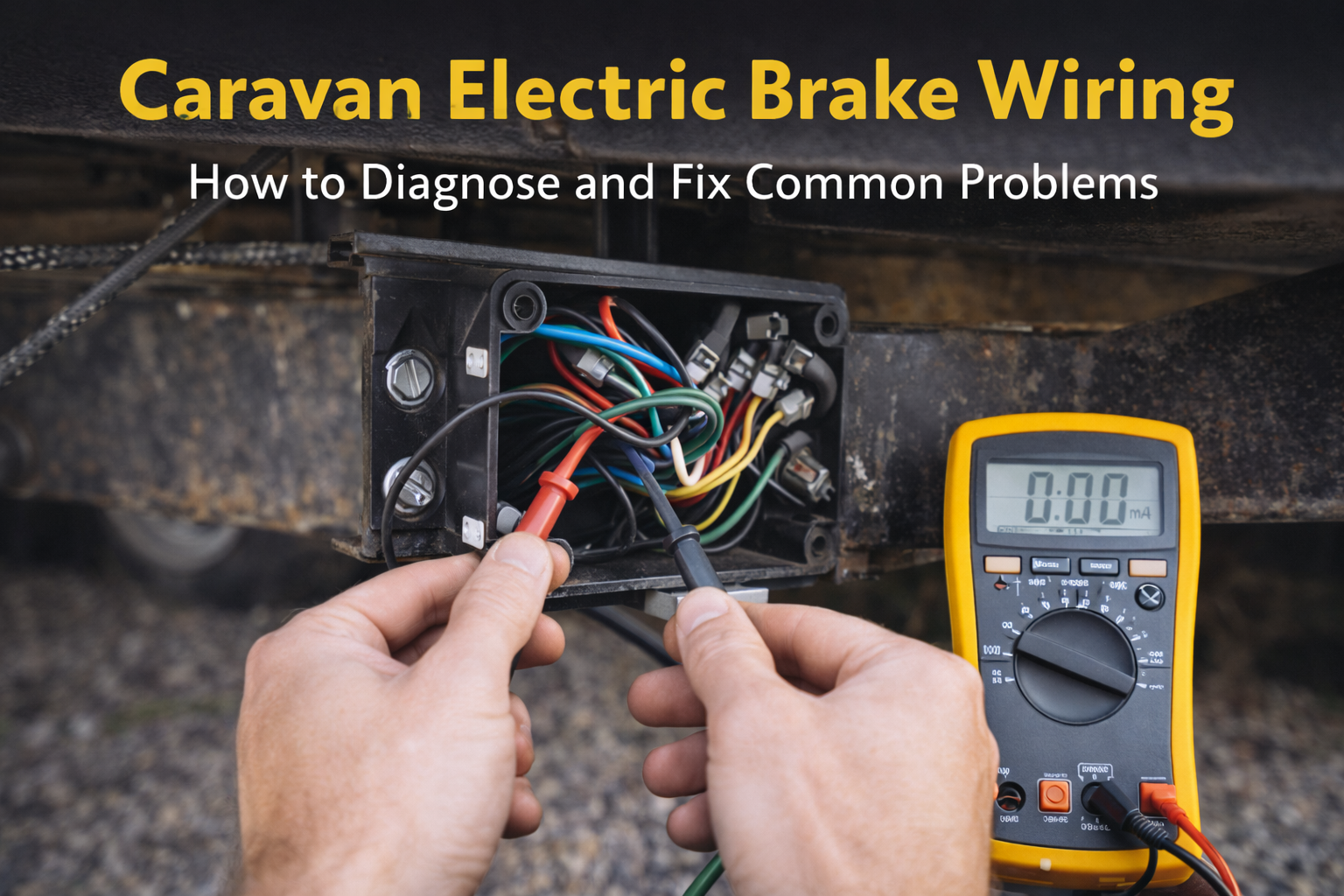
Travel Trailer Electric Brake Wiring: How to Diagnose and Fix Common Problems
When Your Brakes Don't Feel Right
You're towing along and something feels off — the brakes are grabbing too hard, barely working, or not responding at all. Before you start pulling apart the travel trailer, most electric brake issues come down to a few common wiring faults that are straightforward to diagnose.
How Travel Trailer Electric Brakes Work
Planning your next road trip?
KamperHub helps you plan routes, track weights, and travel with confidence. Free to use — no credit card required.
Get Started FreeA quick overview so the troubleshooting makes sense:
- Your tow vehicle's brake controller senses when you press the brake pedal
- It sends a 12V signal through the trailer plug to the travel trailer
- The signal reaches the brake magnets inside each wheel hub
- The magnets engage the brake drums, slowing the travel trailer
The system relies on a clean electrical circuit from the brake controller, through the plug, along the travel trailer's wiring, to the brake magnets, and back via the earth return. Any break, corrosion, or poor connection in that circuit affects braking.
Start at the Plug
The trailer plug is the most common source of electric brake problems. It's exposed to weather, road grime, and gets connected and disconnected constantly.
7-Pin Flat (Standard American)
- Pin 2 (blue wire): Electric brake signal
- Pin 3 (white wire): Earth/ground return
12-Pin Flat
- Pin 2 (blue wire): Electric brake signal
- Pin 1 (white wire): Earth/ground return
What to check:
- Pull the plug apart and inspect the pins — look for corrosion (green or white buildup), bent pins, or blackened contacts
- Clean with contact cleaner or fine sandpaper
- Check that the plug housing isn't cracked or holding water
- Wiggle the plug while connected — if brakes cut in and out, you've found a loose connection
- Check the wiring where it enters the plug — road vibration can break wires right at the crimps
Check the Earth Connection
Poor earth (ground) is responsible for more travel trailer electrical problems than any other single cause. The brake circuit needs a solid earth return to work properly.
Symptoms of a bad earth:
- Brakes work weakly or inconsistently
- Brakes work on one side but not the other
- Brake controller shows "no trailer" or erratic readings
- Lights dim when brakes are applied
Where to check:
- Earth wire at the trailer plug (both vehicle and travel trailer side)
- Earth connection to the travel trailer chassis (usually a bolt near the A-frame)
- Make sure the earth point is clean metal — paint, rust, or corrosion prevents a good connection
- Run a temporary earth wire directly from the travel trailer chassis to the tow vehicle chassis to test — if brakes improve, your earth connection is the problem
Test the Brake Controller
The brake controller in your tow vehicle should display activity when you press the brake pedal with the travel trailer connected.
Quick tests:
- Dashboard display: Most controllers show a bar graph or number when brakes are applied. If it shows nothing with the trailer connected, check the plug connection first
- Manual override: Use the manual brake lever on the controller while driving slowly. You should feel the travel trailer brakes engage. If nothing happens, the issue is downstream of the controller
- Gain setting: If brakes feel weak, try increasing the gain (sensitivity) setting. If they grab too hard, reduce it. The correct setting depends on your travel trailer's loaded weight
Inspect the Breakaway Switch
The breakaway switch is a safety device that applies the travel trailer brakes if the trailer becomes detached from the tow vehicle. A faulty breakaway switch can cause brake problems during normal towing.
Location: Usually mounted on the A-frame or drawbar, with a pull-pin connected to the tow vehicle by a cable
Common issues:
- Pin not fully seated — the switch may be partially engaged, applying brakes intermittently
- Corroded contacts — the switch lives in an exposed position and corrodes over time
- Flat breakaway battery — the switch has its own small battery (usually 12V sealed lead-acid). If it's flat, the breakaway system won't work in an emergency. Test and replace annually
Test it: Pull the pin out while the trailer is stationary with the wheels chocked. The brakes should lock on. Push the pin back in and they should release.
Check the Brake Magnets
If everything above checks out, the brake magnets themselves may be worn.
Signs of worn magnets:
- Brakes feel weak even with the controller gain turned up
- Grinding or scraping noise when braking
- Uneven braking (van pulls to one side)
How to check:
- Remove the wheel and brake drum
- The magnet is the flat rectangular piece inside the drum assembly
- Look for a smooth, worn surface — a new magnet has visible grooves/texture
- Measure the magnet face with a straight edge — if it's concave (worn in the middle), replace it
- Magnets should be replaced in pairs (both sides of the same axle)
Resistance test: Use a multimeter to measure resistance across each magnet. A healthy magnet reads 3-5 ohms. Open circuit (infinite resistance) means the magnet coil is broken.
Wiring Diagram Resources
If you need the specific wiring diagram for your travel trailer:
- Contact the manufacturer — Jayco, Forest River, Keystone, Grand Design, etc. can usually email model-specific diagrams from their service database
- Check your owner's manual — sometimes there's a basic schematic included
- REDARC and Tekonsha have generic electric brake wiring guides on their websites that cover standard pin configurations
- Model-specific Facebook groups — other owners with the same van often have diagrams and experience with common issues
For basic continuity testing, a generic 7-pin or 12-pin wiring diagram is usually enough, since most American travel trailers follow the same standard.
When to Call an Auto Electrician
Some jobs need professional tools and experience:
- Intermittent faults that you can't reproduce reliably
- Wiring damage inside walls or under the floor
- Brake controller installation or replacement
- After any accident that may have damaged the wiring or chassis
- If you're not confident working with 12V electrical systems
Look for an auto electrician with travel trailer experience — not all sparks are familiar with trailer wiring. Ask your local travel trailer dealer or club for recommendations.
Cost guide: A diagnosis and basic repair is usually an hour or two of shop time. A full rewire of the brake circuit costs several times that, depending on the trailer — ask for a written quote.
The Bottom Line
Most travel trailer electric brake problems come down to three things: corroded plug connections, poor earth, or worn magnets. Start at the plug, work your way back through the circuit, and you'll find the fault. Don't ignore brake issues — they're a safety system, not a convenience.
Worried about your travel trailer's towing setup? [KamperHub's weight compliance tools](https://app.kamperhub.com/tools) help you check your GVWR, GCWR, and tongue weight so your rig is safe and legal.
Useful Resources
Join the Conversation
Found this helpful? Try KamperHub — it's free
Weight tracking, trip planning, and towing compliance — all in one app.
KamperHub Team
Helping travelers tow safely and confidently. KamperHub provides tools for trip planning, weight compliance, and adventure management.
Plan Your Next RV Adventure with KamperHub
Trip planning, weight tracking, fuel management, and more. Everything you need for safe and confident towing.
Get Started Free