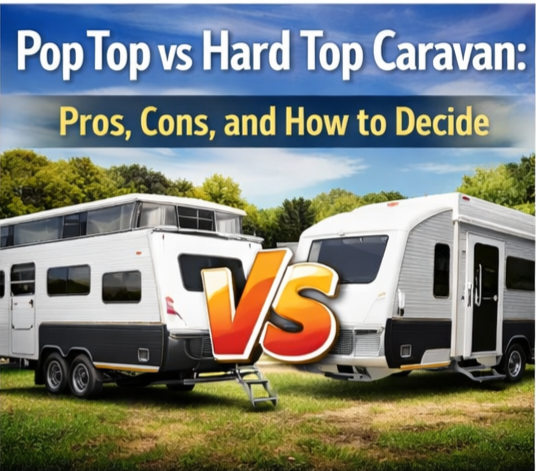
Pop Top vs Hard Top Travel Trailer: Pros, Cons, and How to Decide
Pop Top vs Hard Top Travel Trailer: Which One Is Right for You?
If you're shopping for a travel trailer and can't decide between a pop top and a hard top, you're not alone. It's one of the most common debates in the RVing community, and the answer depends entirely on how you travel.
Both have genuine advantages. Here's an honest breakdown to help you decide.
What's a Pop Top?
A pop top (also called a lifting roof or pop-up top) has a roof section that raises and lowers. When driving, the roof sits flat, giving you a lower profile. At camp, you crank or push it up to create full standing height inside, with canvas walls filling the gap.
What's a Hard Top?
Planning your next road trip?
KamperHub helps you plan routes, track weights, and travel with confidence. Free to use — no credit card required.
Get Started FreeA hard top is a conventional travel trailer with fixed solid walls and a permanent roof. What you see is what you get — full height all the time, no setup required.
Pop Top: The Pros
Lower Towing Profile
This is the big one. A pop top sits significantly lower on the road, which means less wind resistance. You'll notice the difference on windy days and when trucks pass you on the highway. Less drag also means better fuel economy.
Lighter Weight
Pop tops are generally lighter than their hard top equivalents. If you're towing with a mid-size SUV or pushing close to your GVWR limits, this can make a real difference.
Fits in a Standard Garage
Most pop tops will fit in a regular residential garage or carport when the roof is down. No need for a dedicated storage yard or tall shed.
Lower Center of Gravity
With the roof down, a pop top has a lower center of gravity while towing. This improves stability, especially in crosswinds.
Often More Affordable
Pop tops tend to be cheaper than comparable hard tops, which can matter when you're starting out.
Pop Top: The Cons
Canvas Maintenance
The canvas walls are the weak point. Over time, canvas can leak, get mouldy, tear, or degrade from UV exposure. Replacing canvas sections isn't cheap — it is a four-figure job on most trailers, and the bill climbs with size.
Less Insulation
Canvas doesn't insulate like solid walls. In cold weather, a pop top can feel like a tent. In extreme heat, it offers less protection too. If you travel in winter or to alpine areas, this matters.
Setup and Pack-Down
You need to raise the roof at every stop and lower it before driving. It only takes a few minutes, but it's an extra step compared to a hard top where you just walk in.
Rain and Wind Limitations
In heavy rain or strong wind, some travelers prefer to keep the roof down and live with reduced headroom. Canvas can flap in wind and isn't as weatherproof as solid walls.
Less Overhead Storage
With a lifting roof, there's limited space for overhead cupboards and fixed cabinetry in the upper section. Some designs work around this, but it's a trade-off.
Security
Canvas walls are easier to cut through than solid panels. While travel trailer break-ins aren't common, a hard top does offer more peace of mind if you're leaving the trailer unattended.
Hard Top: The Pros
Walk In and You're Done
No setup. Open the door, walk in, full height. This is especially appreciated after a long day of driving or when you're only stopping for one night.
Better Insulation
Solid walls with proper insulation keep you warmer in winter and cooler in summer. If you're traveling through varied climates or chasing the cold, a hard top handles it better.
More Storage Space
Fixed overhead cupboards, taller wardrobes, and more permanent fixtures. A hard top gives manufacturers more room to work with for internal layout.
More Weatherproof
Rain, wind, dust — a hard top handles it all without a second thought. No canvas to worry about, no leaks at the seams.
Better Resale on Some Models
Popular hard top models from well-known brands tend to hold their value well on the second-hand market.
More Secure
Solid walls and proper locks. Better for leaving the trailer at a travel trailer park while you go exploring for the day.
Hard Top: The Cons
Heavier
A hard top is typically heavier than an equivalent pop top. This means you need a vehicle with higher tow ratings, and your fuel consumption will be higher.
Higher Profile
More wind resistance, more sway in crosswinds, and generally harder to tow — especially for less experienced towers. You'll feel it when a road train passes.
Won't Fit in Most Garages
Standard garage height is around 2.4m. Most hard top travel trailers are 2.8m to 3.2m tall. You'll need off-site storage or a tall shed.
Higher Purchase Price
All else being equal, a hard top will cost more than a pop top of similar size and spec.
Harder on Fuel
The combination of heavier weight and higher wind profile means you'll use more fuel, especially on highway trips.
Quick Comparison
| Feature | Pop Top | Hard Top |
|---|---|---|
| Towing ease | Better (lower, lighter) | Harder (taller, heavier) |
| Wind resistance | Lower | Higher |
| Fuel economy | Better | Worse |
| Garage storage | Usually fits | Rarely fits |
| Insulation | Poor (canvas) | Good (solid walls) |
| Weather protection | Average | Excellent |
| Setup time | 2-5 minutes each stop | None |
| Internal storage | Less (limited overhead) | More |
| Canvas maintenance | Yes (ongoing cost) | No |
| Price | Generally cheaper | Generally more expensive |
| Security | Lower | Higher |
So Which Should You Choose?
Choose a pop top if:
- You tow with a smaller vehicle close to its limits
- You mostly travel in warm weather or stay north
- You want to store the trailer at home in your garage
- You do lots of short stops and don't mind the setup
- Budget is a factor
Choose a hard top if:
- You travel in varied climates including cold weather
- You want to walk in and be set up immediately
- You're doing extended trips or full-time travel
- You want maximum storage and overhead cupboards
- You have a capable tow vehicle with capacity to spare
The honest answer? Neither is objectively better. It comes down to how you travel, where you go, and what annoys you more — wind on the highway or setting up canvas at camp.
If you can, try to borrow or hire both types before buying. A weekend in each will tell you more than any pros and cons list.
Plan Your Next Travel Trailer Adventure with KamperHub
Whichever style you choose, KamperHub helps you plan trips, track weights, manage packing lists, and make sure your rig is safe and legal before you hit the road.
Start your free trial and see how it works.
Useful Resources
Join the Conversation
Found this helpful? Try KamperHub — it's free
Weight tracking, trip planning, and towing compliance — all in one app.
KamperHub Team
Helping travelers tow safely and confidently. KamperHub provides tools for trip planning, weight compliance, and adventure management.
Plan Your Next RV Adventure with KamperHub
Trip planning, weight tracking, fuel management, and more. Everything you need for safe and confident towing.
Get Started Free