
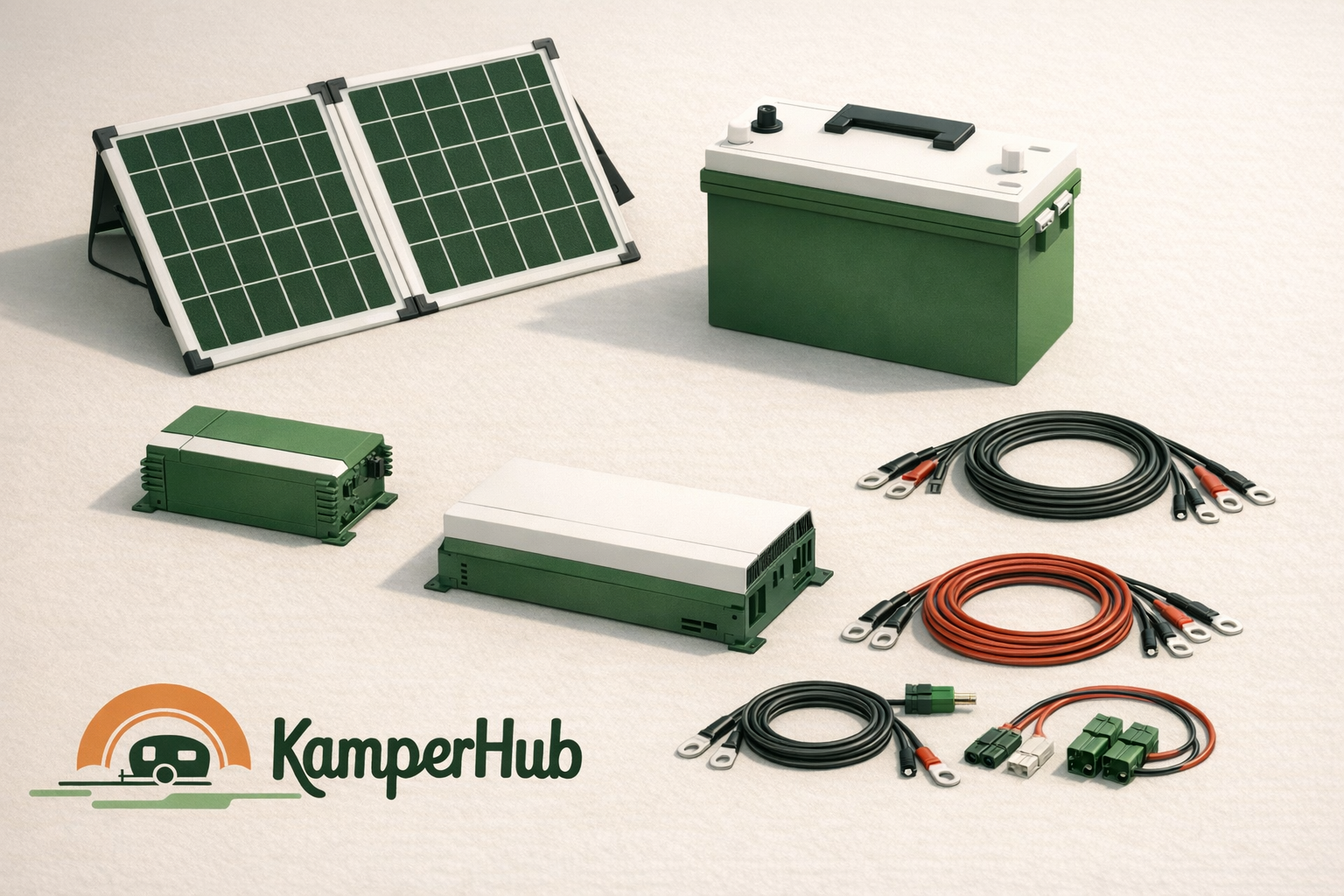
How to Size Your Travel Trailer Power System (Without Getting It Wrong)
The Problem With Guessing
Most people set up their travel trailer power system by asking a mate, reading a forum post from 2019, or just buying whatever the shop assistant recommends. The result? Either a system that costs twice what it should, or one that leaves you in the dark by 9pm.
The good news is that sizing a power system isn't complicated. You just need to know three things:
- How much power you actually use each day
- How you'll recharge (solar, driving, generator)
- How long you want to stay off-grid without plugging in
Once you know those numbers, everything else falls into place.
Step 1: Work Out Your Daily Power Usage
Planning your next road trip?
KamperHub helps you plan routes, track weights, and travel with confidence. Free to use — no credit card required.
Get Started FreeEvery appliance in your travel trailer draws a certain number of watts. Multiply watts by hours of use per day, and you get watt-hours (Wh) — your daily energy consumption.
Here are some common appliances:
| Appliance | Watts | Hours/Day | Daily Wh |
|---|---|---|---|
| Compressor fridge | 20W avg | 24h | 480 Wh |
| LED lights | 20W | 5h | 100 Wh |
| Phone charger (x2) | 15W | 3h | 90 Wh |
| 12V fan | 24W | 8h | 192 Wh |
| Water pump | 60W | 0.5h | 30 Wh |
| Laptop | 65W | 2h | 130 Wh |
Why 20W and not 50W? A compressor fridge cycles — the compressor only runs perhaps 30–50% of the time, depending on the ambient temperature, where the thermostat sits and how often the door gets opened. The ~50W on the spec sheet is what it draws while the compressor is running, not around the clock. What a daily-usage table needs is the 24-hour average, which for a typical travel trailer fridge is about 20W, or roughly 30–50Ah a day. Multiplying the running draw by 24 hours is the most common way people talk themselves into twice the battery they need. Expect the top of that range in summer.
Typical daily usage: roughly 1,000–1,500 Wh for a couple traveling with a fridge, lights, fans, and devices — the appliances listed above come to about 1,020 Wh. Hot weather pushes it toward the top of that range, because the fridge cycles more often.
Don't guess — add up your actual appliances. We built a free Power System Planner that does this calculation for you. Just tap your appliances and it works out the rest.
Try the Power System Planner →
Step 2: Choose Your Battery
Your battery stores the energy you use overnight and between charges. The three main types are:
Lithium (LiFePO4) — The Clear Winner
- 80% usable capacity (a 200Ah battery gives you 160Ah)
- 3,000+ charge cycles (lasts 8–15 years)
- Lightweight — about 49 lb for 200Ah
- Fast charging — fully charged in 2–4 hours
- Cost: ~$4.50/Ah ($900 for 200Ah)
AGM — The Budget Option
- 50% usable capacity (a 200Ah battery only gives you 100Ah)
- 500 charge cycles (lasts 3–5 years)
- Heavy — about 130 lb for 200Ah
- Slow charging — 6–10 hours
- Cost: ~$2.00/Ah ($400 for 200Ah)
The Maths
Lithium costs more upfront but is cheaper per cycle. A $900 lithium battery lasting 3,000 cycles costs $0.30 per use. A $400 AGM lasting 500 cycles costs $0.80 per use.
For most travel trailer setups, 200Ah of lithium is the sweet spot. It gives you 160Ah of usable power — enough for about two days of typical use without any charging.
Read the Battery Buying Guide →
Step 3: Set Up Your Charging
Your battery is only as good as your ability to recharge it. Most setups use a combination of these:
Solar Panels
The most popular off-grid charging source. A 200W panel with 5 hours of sun produces about 800Wh per day (after efficiency losses). That covers a basic setup but may fall short in cloudy weather or winter.
Tip: Always oversize your solar. A 400W setup gives you a buffer for bad weather.
DC-DC Charger
Charges your house battery from your vehicle alternator while driving. A 30A DC-DC charger driving for 3 hours puts about 970Wh into your battery. Essential if you're touring (driving most days) rather than sitting at one campsite.
Popular brands: REDARC, Enerdrive, Renogy
Generator
A backup option for extended cloudy periods. Most people don't want to rely on one, but a small 2kW generator can fully recharge a 200Ah battery in a few hours.
Shore Power
If you stay at powered travel trailer parks sometimes, your onboard charger will top up the batteries overnight. This resets your off-grid clock.
Step 4: Do You Need an Inverter?
An inverter converts your 12V battery power to 240V mains power. You need one if you want to run:
- Microwave
- Hair dryer
- Electric kettle
- Coffee machine
- Any appliance with a regular power plug
Pure sine wave inverters are recommended — they're safe for all electronics. Modified sine wave inverters are cheaper but can damage sensitive equipment.
Sizing: Your inverter needs to handle the highest single load. If your microwave draws 1,000W, you need at least a 1,500W inverter (to handle the startup surge).
Putting It All Together
Here's a typical setup for a couple doing a mix of free camping and travel trailer parks:
| Component | Spec | Approx. Cost |
|---|---|---|
| Battery | 200Ah Lithium (LiFePO4) | $900 |
| Solar | 2 x 200W panels (400W total) | $800 |
| MPPT Controller | 30A | $200 |
| DC-DC Charger | 30A (e.g. REDARC BCDC1250D) | $550 |
| Inverter | 2,000W pure sine wave | $400 |
| Total | ~$2,850 |
This setup gives you:
- Indefinite off-grid in good weather (solar covers daily usage)
- 2–3 days in cloudy weather before needing to drive or plug in
- 240V power for a microwave, kettle, and laptops
Use the Free Power System Planner
Rather than doing all this maths by hand, use our Power System Planner. It walks you through:
- Listing your appliances (with common presets)
- Setting your off-grid target (how many days)
- Configuring your charging (solar, DC-DC, generator, inverter)
- Getting battery recommendations (size, type, cost)
- Seeing your full system summary (with a shopping list)
It's free to use — no signup required for the first three steps.
Useful Resources
Join the Conversation
Found this helpful? Try KamperHub — it's free
Weight tracking, trip planning, and towing compliance — all in one app.
KamperHub Team
Helping travelers tow safely and confidently. KamperHub provides tools for trip planning, weight compliance, and adventure management.
Plan Your Next RV Adventure with KamperHub
Trip planning, weight tracking, fuel management, and more. Everything you need for safe and confident towing.
Get Started Free