
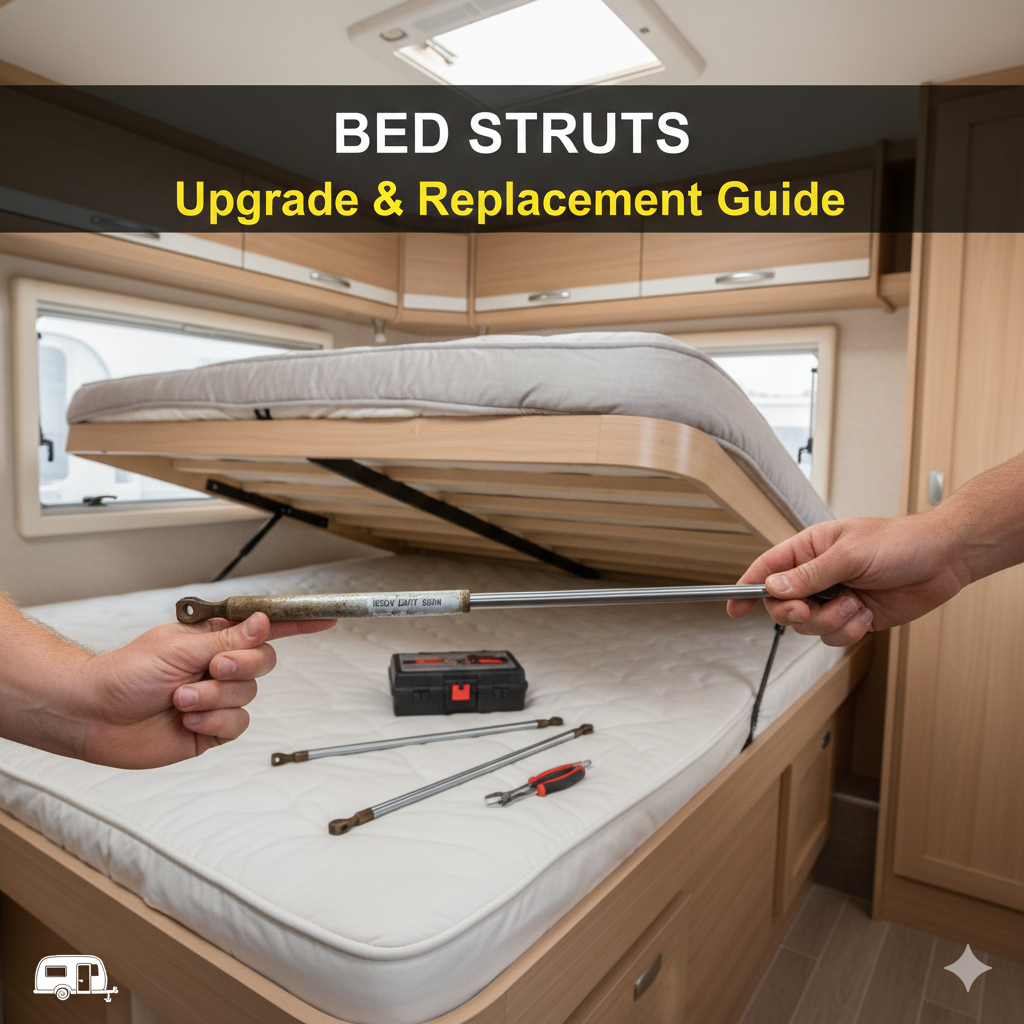
Caravan Bed Gas Struts Not Holding? How to Choose and Replace Them Yourself
The Problem
Your caravan bed lifts up on a hinge to reveal under-bed storage — but the gas struts that are supposed to hold it open have given up. The bed slowly sinks back down the moment you let go, or it will not stay up at all without someone holding it.
Retrieving anything from storage becomes a two-person job: one person holds the bed up while the other digs around underneath.
This is one of the most common caravan complaints, and the fix is straightforward. Gas struts wear out over time, and replacing them is a job you can do yourself in under an hour.
Why Gas Struts Fail
Planning your next road trip?
KamperHub helps you plan routes, track weights, and travel with confidence. Free to use — no credit card required.
Get Started FreeGas struts are sealed cylinders filled with pressurised nitrogen gas. Over time they lose pressure — just like a car's shock absorbers. Common reasons for failure:
- Age and wear — Gas slowly leaks past the internal seals. Most struts last 3–7 years depending on use
- Heavier mattress — If you have upgraded to a thicker or heavier mattress (memory foam, pillow-top, or added a topper), the original struts may no longer have enough force to hold the extra weight
- Extra bedding — Even adding a heavy doona or blankets increases the load on the struts
- Heat cycling — Constant temperature changes in the caravan weaken the seals over time
- Corrosion — Moisture and salt air can corrode the shaft, damaging the seal
If your struts are sinking slowly, they are losing gas. If they do absolutely nothing, they are completely dead. Either way, replacement is the answer.
How to Measure Your Existing Struts
Before ordering replacements, you need three pieces of information from your current struts.
1. Extended Length
Measure the strut from the centre of one end fitting to the centre of the other end fitting when the strut is fully extended (bed open). This is the overall length. Write this down in millimetres.
2. Compressed Length
Measure the same way but with the strut fully compressed (bed closed). The difference between extended and compressed length is called the stroke.
3. Force Rating (Newtons)
Look on the body of the strut for a number followed by the letter N — for example, 450N. This is the force rating in Newtons.
If the label has worn off, you can test the old strut by pressing it against bathroom scales. Read the kilogram force, then multiply by 10 to get the Newton rating. A strut that pushes with 35 kg of force is roughly 350N.
Quick conversion: Newtons divided by 10 equals approximate kilograms. So 450N is about 45 kg of force.
4. Fitting Type and Size
Check how the strut attaches at each end. The most common fitting on Australian caravans is a 10 mm ball joint — a small metal ball that snaps into a socket on the mounting bracket. Some struts use pin fittings, clevis forks, or eyelet ends instead.
Measure the ball size (usually 10 mm or 13 mm) and note whether both ends are the same type.
How to Choose the Right Replacement
Same Size, Same Force
If your original struts worked fine before they wore out and you have not changed the mattress, order replacements with the same extended length, compressed length, and Newton rating as the originals.
Need More Force?
If you have added a heavier mattress or topper, you will need struts with a higher Newton rating. Here is a rough guide:
| Bed Size | Typical Strut Force (per strut, pair of 2) |
|---|---|
| Single / King Single | 200N – 300N |
| Double | 300N – 400N |
| Queen | 400N – 500N |
| King | 500N – 600N |
These are ballpark figures. Actual requirements depend on the weight of your specific mattress and bedding, the hinge position, and where the struts mount.
Do Not Go Too Strong
It is tempting to buy the strongest struts available, but struts that are too powerful create problems:
- The bed becomes very difficult to push back down — you may need to physically lean on it
- The mounting brackets and hinges take excessive stress
- Over time, overpowered struts can pull mounting screws out of the plywood bed base
Aim for struts that hold the bed up comfortably at about 45 degrees but can still be pushed closed with reasonable force.
When in Doubt
If you cannot find the original specs and are unsure, contact the strut supplier with your caravan make, model, and bed size. Australian suppliers like CaravansPlus, Struts Australia, and StrutsWest carry struts matched to specific caravan models.
Where to Buy in Australia
| Supplier | Website | Notes |
|---|---|---|
| CaravansPlus | caravansplus.com.au | Wide range, sizing guide, caravan-specific |
| Struts Australia | strutsaustralia.com.au | Dedicated caravan bed strut collection |
| StrutsWest | strutswest.com.au | Struts matched to Jayco and other models |
| Stabilus Australia | stabilus-struts.com.au | Major manufacturer, wide range |
| Aussie Traveller | aussietraveller.com.au | RV bed base struts |
| Supercheap Auto / Repco | In-store | Stock generic gas struts in common sizes |
Typical cost: $25–$60 per strut depending on size and force rating. You will need two struts for most caravan beds.
How to Replace Them (Step by Step)
This is a 15–30 minute job. No special tools required.
Tools You Will Need
- Flat-head screwdriver or small pry bar (to pop ball joints off)
- Ratchet strap or a helper (to hold the bed open during the swap)
- Rag or towel (old struts may have oil residue)
Steps
- Prop the bed open — Use a ratchet strap, a length of timber, or get someone to hold the bed up. Do not rely on the old struts to hold it while you work underneath.
- Remove the old struts — If they have ball joint fittings, use a flat-head screwdriver to gently pry the socket off the ball. One end will usually pop off easier than the other. Remove the lower end first (the end mounted to the bed frame), then the upper end (mounted to the underside of the bed base).
- Compare old and new — Hold the old strut next to the new one to confirm the length matches. Check the fittings are the same type and size.
- Fit the new struts — Attach the upper end first (to the underside of the bed base), then push the lower end onto its ball. You should hear a firm click when the ball joint seats. The strut should be installed with the shaft (thin rod) pointing down — this keeps the internal seal lubricated and extends the strut's life.
- Test — Carefully release the prop or strap and let the struts take the load. The bed should rise smoothly and hold itself open at a comfortable angle. Push it closed — it should compress with moderate effort.
- Check the mountings — After fitting, inspect the mounting brackets and screws. Make sure nothing has loosened. If the original screws have pulled out of the plywood, fill the holes with epoxy or use larger screws with a backing plate.
Alternative Solutions
Add a Third Strut
If two struts are not quite enough but the next Newton rating up is too strong, some owners add a third strut in the centre. This distributes the load more evenly and avoids overstressing the mounting points.
Repositioning the Mounting Points
Moving the lower mounting point slightly further from the hinge increases the effective leverage of the strut, giving more lift without changing the strut itself. This requires drilling new mounting holes, so only do this if you are confident with the modification.
Prop Rod or Timber Stay
The simplest short-term fix is a telescoping prop rod or a cut-to-length piece of timber that wedges between the bed base and the floor of the storage compartment. Not elegant, but it works reliably while you wait for new struts to arrive.
12V Linear Actuator
For a more advanced upgrade, some owners replace gas struts with a 12V linear actuator — press a switch and the bed raises or lowers electrically. Off-the-shelf actuators with internal limit stops are available for under $50. This is a permanent fix that never loses pressure, though it does require a simple 12V wiring connection.
Maintenance Tips to Make Them Last
- Keep the shaft clean — Wipe the chrome shaft with a clean cloth periodically. Dirt and grit on the shaft damages the internal seal and causes gas leaks
- Lubricate the shaft — A light coat of silicone spray on the shaft helps protect against corrosion, especially in coastal or humid environments
- Install shaft-down — Always mount gas struts with the shaft (thin rod) pointing downward. This keeps the internal oil on the seal, which extends the life of the strut significantly
- Avoid slamming — Let the bed down gently rather than dropping it. Slamming creates shock loads that accelerate wear
- Check mountings annually — Tighten screws and inspect brackets for cracks or bending as part of your regular caravan service
Summary
Worn-out gas struts are the reason your bed will not stay up. The fix is simple:
- Measure your existing struts (extended length, compressed length, Newton rating, fitting type)
- Order replacements from an Australian caravan supplier ($25–$60 per strut)
- Pop the old ones off, snap the new ones on — 15 to 30 minutes
- Mount them shaft-down, keep them clean, and they will last for years
No more two-person bed lifting operations.
KamperHub helps caravan owners manage vehicle specs, track weights, and plan trips across Australia. [Start your free trial today](https://app.kamperhub.com).
Join the Conversation
Found this helpful? Try KamperHub — it's free
Weight tracking, trip planning, and towing compliance — all in one app.
KamperHub Team
Helping travellers tow safely and confidently. KamperHub provides tools for trip planning, weight compliance, and adventure management.
Plan Your Next Caravan Adventure with KamperHub
Trip planning, weight tracking, fuel management, and more. Everything you need for safe and confident towing.
Get Started Free